Making Negatives Releases Endorphins

It’s true: processing film ranks right up there with running, and with making good-looking entrees.

Let’s consider what one would need to make ’em  (negatives) at home and how to do it. You can find this information at plenty of locations on the World Wide Intercom, so I’ll do it as though we’re chatting.

Bare minimum: reel & tank & lid & cap, clock, thermometer, dark. Developer, fixer, water.

One step up: a photo thermometer, a (darkroom) timer, hypo clearing agent, wetting solution.

The chemicals, in reverse order:

Wetting solution is sold as LFN or Photo Flo 200 (you don’t need Photo Flo 600).  For either, drop a drop or two into a pint of water for a final rinse of 30-60 seconds. Any suds you generate in this will run off and leave nothing on the film. The pint is usually good for all day. An alternate method I’ve not tried is to spray the film, hanging in position to dry, with distilled water from a plant, Mister (I mean, a plant mister).

Hypo clearing agent (HCA) breaks down the fixer that remains on film (or in paper fibers) so that the wash times may be kept to an efficient minimum. Implied in that: enough washing makes HCA unnecessary. Kodak makes it, and so does Edwal and others; it’s easy to make with just a couple of common chemicals and a scale. You know what, though: just pick up a quart of Perma Wash. 3 ounces makes a gallon; nothing to it.

Fixer is a sine qua non of processing, so get over the aroma, OK? Most gang darkrooms use Kodak Rapid Fixer (there are equivalents) because it’s cost effective, but the critical thing is not to overextend its use. It’s very important to know how much material has gone through a given batch of working solution fixer. I’ve always been reluctant to mix from packages in powder form (fear of contamination), and the extra expense of liquid concentrate is a small upgrade. Until I changed fixers a while back (BIG upgrade; more later) I usually preferred Edwal Quick Fix.

“Working solution?” Most, if not all, rapid fixer liquid concentrates get diluted 1:3 for film and 1:7 for prints, although there are reasons to stick with 1:3 for paper as well. This means that for our paltry needs, eight ounces of rapid fixer makes a quart of working solution fixer good for a dozen rolls of film in a six-month period. Be sure to stir thoroughly, until all the striations are gone, and it will remain in solution from then on.

So. If you make HCA by mixing one ounce of Perma Wash into a third of a gallon of water, that will last as long as the quart of fixer. Keep a tally and dates on the containers. Simple and reliable.

The biggest, most important deal of all is the developer. Perhaps no one but you will be aware of the difference that the choice of a developer makes, but oh, you’ll know. Seems odd, I know, not to touch on the fine points of types of grain and compensating qualities and exposure indices, but right now let’s be practical.

Xtol is currently the reigning developer in terms of quality, flexibility and cost effectiveness; it’s easy to mix at room temperature, it’s relatively environmentally friendly citric acid-based) and it acts as its own replenisher. The only catch is that it must be purchased and mixed in FIVE LITER batches! Originally it was also available in one-liter packages, but there were quality control problems in manufacture. This brings us back to previous gold standards among developers: D-76 and HC-110.

D-76 was first concocted (see how far out of my way I go to avoid saying it was developed?) in 1927 as a “fine-grain” motion-picture film developer. It’s still the standard to which every other formula compared. There are home-brew variations, but every darkroom worker has it memorized: 400TX, 1:1, 68F., 10 minutes. The stuff is available in packages to make one quart at a time. For 35mm that’ll do eight rolls at a 1:1 dilution. It keeps for six months in a filled and stoppered glass bottle, and when the bottle becomes partially full, the guarantee slips to 2 months; still not bad.  

HC-110 comes as viscous pint (yellow or orange? It changed from one to the other) that you first dilute to a half-gallon, and then further as needed. There are at least 8 recommended dilutions, all with their own times. In school we diluted only a half-ounce or so at a time from the pint; I don’t know why we thought that was accurate, with its syrupy consistency. Times are seductively short. Don’t fall for it. Only if your processing techniques are flawless would I suggest you go this route.

What else do you need? A dust-free place to hang film to dry, and a clip for hanging. I don’t know any dust-free places, but if things aren’t stirred up you should be fine. Keep large dogs out of the room, and don’t use catnip as a weight on the bottom end. Although a slight weight is nice to have (especially in low humidity) to discourage curling, it’s equally effective to crease the blank leader backward against the curl twice, and all will be well.

If anything is unclear or you want me to elaborate, just post a comment. As Ted did. Thanks for the kick in the pants.

Update: http://www.holgablog.com/2009/03/20/processing-bw-film-and-how-i-do-it/ is a pleasant tutorial by “Veronica.” It includes a link to an Ilford pdf of the same stuff in more formal terms.
Oh, we could quibble…

This rambling list is a hoot. A number of the “tips,” however, look like terrific picture-making strategies if they’re done with clear intention. Feel free to chip in with additional items, to extend the list.

http://gawno.com/2009/05/78-photography-rules/

Hoax is such an ugly word.

What exactly does it mean to you when you’re told that photographers “faked their images?”
http://www.bjp-online.com/public/showPage.html?page=864044

 
Enjoy the “documentary” essay (if you can view pictures in French): http://paiement.parismatch.com/photoreportage2009/unalbum3.php?id=9&ord=9

According to the report, Paris Match has changed the nature of its competition for next year.

NYT Has A Photo Blog

http://lens.blogs.nytimes.com/2009/05/29/readers-photos/

…is a collection of readers’ Polaroids. It’s a great way for you to begin looking at their variety of posts, all of which are very high quality.

AP Art Show

It’s up, and it’s stunning.


Come see it in the Clair E. Smith Gallery and adjacent hallway cases sometime over the next 10 days or so; a good time would be the evening of the 30th, Thursday, due the likely appearance of the You-Know-Whos.

Plus refreshments. Your comments on the show are more than welcome here.

(The above photographs were made by Stef Tollefsen and Andi Argianas, respectively.)

Let’s Review, Shall We?

FTE: A full-time teacher in the Hah Thkoo has five classes. When I was hired I was .6 for the first three semesters, .8 for another year, and full-time thereafter. If the board were to authorize three new FTE (Full Time Equivalents) anytime for the following school year, in theory five new teachers could be hired at 3/5 (.6) each, maybe spread over departments. That’s FTE.

But we’ve had TWO BFTE in the last week. First was the perfect weather day for shooting in The Park Of Wicker and Katiebrown Bucktown, then the ever-so-pleasant stroll in the mist to galleries. It was a gas. Literally. Ask ’em about being trapped underground.

http://www.davejordanophotography.com/

http://jedfielding.com/photos/look-at-me-photos.html

http://www.ninaberman.com/index3.php?pag=prt&dir=imageshp

http://schneidergallerychicago.com/section/89248.html

I Believe (in) Stephen Shore

Not to put too fine a point on it, but this is currently the most nourishing video piece available to you:

http://www.youtube.com/watch?v=6m5flmLiEDA

Also: look for, covet, and acquire ” The Nature of Photographs” by Stephen Shore. Thank you, and good night.

SoFoBoMo

You can make a book, and you should make a book, and there is a structure within which you will make a book: it’s Solo Photo Book Month, a variation of a similar activity for writers, wherein willing participants “make” a book of photographs (at least a PDF version) of  at least 35 pictures, during a 31-day period between May 1 and June 30.

http://www.sofobomo.org/2009/

Take a look at the previous efforts and the perameters for your project, and I think you’ll want to register for your own project. Let us know about your registration/commitment.

214’s Classy Affair

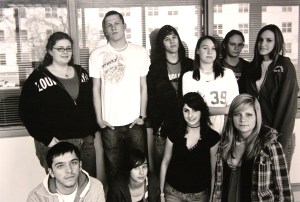
Earlier this month I had the pleasure of conducting a colloquium at District 214’s Film & Photography Day. The annual event has matured nicely into a substantial affair: there was a keynote speaker and 10- count ’em, 10- workshops. Art students were transported from many, if not all, of the high schools in the district.

When Ms. Schrenk of Elk Grove (BHS Class of 1997) asked me what I would like beforehand, I suggested that people bring one of their most recent successful pictures, as well as a picture they admire from wherever else. She told me that attendees did not pick their day’s activities in advance, so that wouldn’t work. Oh, well; I could still address issues that affect artists over the long term, which was my intent anyway, because I need not reinforce the egos of those who skim the surface of picture-making, but rather I prefer to talk with people looking for a way to make a commitment to their work.

The title of my workshop was “Your Place in Photo History,” intentionally adult/stuffy, but what chance does it have when the adjacent one on the list was “I’m Going to Scare the Pants Off America”? In addition, the speaker standing next to me, Ms. Price of BG, dealt with (totally non-threatening) toy cameras! Still, enough people signed on with moi to make for nice cozy groups.

At lunch (EXcellent food, Smithers), we were treated to classic cartoons. The gentleman (eerily evocative of Jeff Albertson [look it up]) who presented the films of William Castle (the “scare the pants off” quote was from him) showed us the first-ever cartoon “Gertie the Dinosaur,” drawn entirely by hand; the not entirely PC “Steamboat Willie;” and two Daffy Duck pieces, one self-referential and one a Cold War allegory.

Ms. Schrenk and I exchanged work afterward, which made my day. That, and I noshed with a girl named Batavia.

If you’re pictured on this post, send me a postcard at BHS, 616 W. Main, Barrington 60010 and I’ll send you a print.

Summer School? Summer School!

Sometimes it seems as though every activity, every event that has been rewarding – field trips, Big Print Days, exhibits, whatever –  has occurred outside the normal bell schedule of the school. That’s because, like baseball and (I’m told) golf, things don’t happen according to the clock. So it is (or feels) with summer school.

Photography in summer school absolutely rocks. The sun is up when we begin, so there’s the free Vitamin D; we ignore the suggested break schedule in favor of going with the flow of the processes; every day is equivalent to a week of regular school; no other class is using the photo rooms, so essentially we take over; a field trip can take place at a smaller, more selective location; what’s not to like? Some people start in the darkroom, some continue, and some work on portfolios.

Photography has now been added to the offerings during the first session of summer school this year. If enough people register it’ll happen; it might fill and close, too. Think about it (but not for too long). Registration may be done online.

  • Calendar

    • May 2026
      S M T W T F S
       12
      3456789
      10111213141516
      17181920212223
      24252627282930
      31  
  • Search