Just Tell Me What You Want

(There was a Hollywood movie by that name once, unseen by me, with a promotional picture of Ali McGraw bludgeoning Alan King with her purse. I’d’ve posted it here but it exists only with text on it. [Sigh.])

Priorities for the Wonderful World of Photography include safety, excellent craft and manifestation of your sensibility. Puh-LEEZE lemme know what I can do for you in the course, in your role as an American consumer (of fine instruments for exposure of film, both new and used), and in your home improvement efforts to convert a lackluster living space into a sanctum for printmaking.

As well: the fledgling Fo-Do Club, which met off and on last year, needs a sense of purpose. Most (not all) of the activities we have discussed are things that happen in class, so… it’s a tad amorphous. We’ll work on that. What suggestions do you have?

On the Reduction of Silver

When I was a short person, I did not yet drink coffee; rather, pots and pots of black tea, and gallons of iced tea in summer. (Note: now it’s “ice” tea, and not because of the performer’s name. Language really does morph. Ice cream used to be “iced” cream, I’m told.) I did not get around to coffee until my late twenties, when I happened to sample un tres bon cafe in Paris. I came back to Chicago, wound (past tense of wend, but only when you’re in a spiral mall) up to the last storefront and whined to Bob Wells, “How can I make coffee like they have in Fraaance?” He pointed to the machines out of reach on the top shelf, machines that ran 500-800 dollars. I wanted coffee that gave the mouth feel of cocoa, but without the sweetness of added sugar. (Plus, coffee does not stain the teeth as badly.)

IMG_1333

Junkies wish they could relive the exhilaration of their first-ever high each time they fix (so I’m told). Is it the same for coffee lovers? Maybe. Compare that to your (conscious or unconscious) attempt to replicate the thrill you had when your first good print came up in the developer. Whoosh, right? Just as a film and developer combination gives you a look that works for you, so can a pairing of paper and developer. Here are ideas about commercially available chemistry for your sanctum.

The K.I.S.S. approach to paper chemistry requires only developer and fixer. The standard developer is Kodak’s Dektol, whose advantage is a little contrast control through dilution. It does throw some sludge in the tray with use, however, and one may (will) acquire a sensitivity to the Metol in it over time. Those are reasons I replaced it in the Hah Thkoo with LPD, which lasts longer (get it? “L” PD), has Phenidone instead of Metol, and allows for subtle shifts of print color by dilution (and, of course, choice of paper). It comes as a can of powder to make a stock solution or as a liquid concentrate. At this writing a quart of liquid concentrate runs $13.00, typically to dilute 1:4. There are many, many choices among pre-mixed paper developers, but it’s unlikely to find anything better for the price.

The second tray in printing is usually water with acetic acid, to neutralize the (base) developer on the drained print. This stops the development, hence the term “stop bath,” and prevents that little bit of developer from contaminating the fixer. Kodak has long offered Indicator Stop Bath, which is a 28% dilution of acetic acid (like vinegar, only 5 or 6 times stronger, not food grade, and a bit more acrid one’s nostrils) with a dye mixed in. Two ounces of this in a gallon makes a yellow solution which appears clear under safelights. Once enough prints have neutralized the acid, the dye turns dark (purple) so you’ll know. In the Huge School we set up a larger tray with an overkill of just water (not “just water,” but probably the hardest tap water in the Northern Hemisphere) which does the trick and is easily replaced as the periods pass.

Fixer: simple. Once again, to avoid inhalation of nasty dusty powders, stick to liquid concentrate. Everybody has a fixer for sale. They all work. Our recommendations: Kodak Rapid Fixer, Edwal Quick Fix, or Formulary TF-4. Each runs somewhere from $10.50-12.00 for a quart of concentrate. As with film fixer, count how many sheets you run through a tray of working solution (don’t bother to add the hardener if any comes with it in a separate bottle), and retire the batch before it’s exhausted. The IEPA will receive your old batches from you (talk to me about that).

That’s it. Almost as simple as Edward Weston’s darkroom. You needn’t bother with hypo clearing agent if you use RC paper, nor fiber if you calculate a diligent wash of small batches and sufficient agitation therein. Let’s play it real safe, by you axing me a ton o’ questions afore ye shop.

Own This Print


KyotoStoreTo request the above photograph:

Send an e-mail (subject: Limited Edition #090814) to jdionesotes@prodigy.net with your name and mailing address.

If you are the first person to respond after the posting, you will receive the photograph via snail.

Update: this picture has been claimed & shipped.

Insights

The Catherine Edelman Gallery has incorporated video/audio statements from photographers who are included in its “The Chicago Project III” exhibit. Enjoy them all (and more, if you dig a little) at http://edelmangallery.com/currentshow.htm. They are, shall we say, elucidating. If you watch only one, dig around the web site to find Jed Fielding, whose pictures of blind Mexican children some of us saw together at the Cultural Center, last April.

“Artists are workers.” -Cecil Taylor

Evan Mirapaul, over at http://fugitivevision.blogspot.com/, had a perceptive comment about Ray K. that deserves repeating.

“How Mr. Metzker organizes space is manifest in a multitude of materials that crop up decade after decade. We see chain link fencing, stairs, bricks, and the geometry of dozens of city views rendered again and again into an abstract cohesion in his viewfinder. It seems that one could organize a show just of his use of fences. Examples from every series (except the landscapes) come to mind. I posited to Ann Tucker that a difference between Harry Callahan and Metzker is that Callahan is almost always more in close and tight; the figure is more personal, while Metzker takes the more distant, objective view. She replied that she thought that Callahan was about the figure represented in a cityscape, while Metzker was more about a cityscape with a figure or figures included in this view; a subtle but important distinction, I think, especially since, even now, people conflate the student with the teacher.”

It behooves us to keep this distinction in mind the next time we work on Metzker’s (and Callahan’s) turf, the Loop, during our field trip.

“Continuing the musical metaphor, I am reminded of a quote by the French conductor and composer Pierre Boulez. He said that, after twenty years, he was finally beginning to be spontaneous. This is not a comment on stiffness and lack of inspiration: it’s a paean to the creativity that comes from discipline. If you work and work and work, you become so entwined with the material that real improvisation is possible. It’s fashionable to just ‘let it all go,’ or ‘just go up and jam,’ but this approach rarely yields true creative fruit. The best jazz artists, indeed artists in general in my view, find spontaneity from a rigorous work ethic and a strict intellectual foundation. I see this in every Metzker photograph. He is a WORKING photographer. That he can riff on his blacks, or his whites, or fences or cityscapes comes from the foundation of a language rooted in visual philosophy. By taking pictures and working in the darkroom non-stop he anneals this language into a body of work that speaks in every picture of inspiration and freedom.”

Parallels

“In life outside music, ambiguity is not necessarily a positive attribute—it is often a sign of indecision and, in politics, a lack of firm direction—but in the world of sound, ambiguity becomes a virtue in that it offers many different possibilities from which to proceed. Sound has the ability to make a link between all elements, so that no element is exclusively negative or positive… Feeling is an expression of the struggle for balance, and it cannot be allowed independence from thought. As Spinoza shows us, joy and its variants lead to a greater functional perfection; sorrow and its related affects are unhealthy and should therefore be avoided. In music, though, joy and sorrow exist simultaneously and therefore allow us to feel a sense of harmony. Music is always contrapuntal, involving an interplay of independent voices, in the philosophical sense of the word. Even when it is linear, there are always opposing elements coexisting, occasionally even in conflict with each other. Music accepts comments from one voice to the other at all times and tolerates subversive accompaniments as a necessary antipode to leading voices. Conflict, denial and commitment coexist at all times in music.”
-Daniel Barenboim, “Music Quickens Time”

Photograph: Frederick Sommer

SoFoBoMo, fo’ sho’

28L

National Novel Writing Month, or NaNoWri Mo, is a non-competition, a challenge to oneself, wherein writers work to complete a 175-page, 50,000 word novel in one month. It’s an up-front admission by that organization: “Make no mistake: You will be writing a lot of crap.’ The fo-do version of this is Solo Photo Book Month, wherein workers make a virtual on-line “book” of at least 35 pictures inside 31 days.

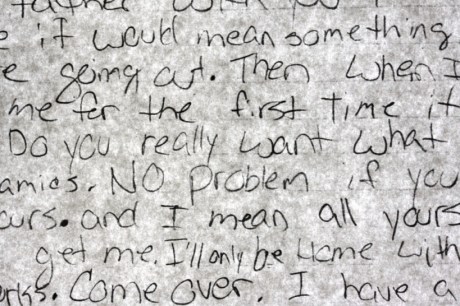
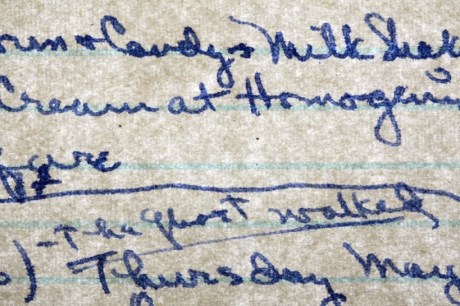
Scraps of paper have been piling up all around me for decades. Since I’ve never had a cigarette, this has not been much of a hazard. Everything seemed to have pictorial potential: notebooks, hand-drawn maps, found notes, anonymous grocery lists (someone has a website of these; hell, that can be said about everything), signs I’ve appropriated (Walker did it too). Keeping in mind the dicta of Garry Winogrand — “Any and all things are photographable” — and of Harold Allen, that what matters is where you put the camera and where you place the edges, I plumbed my archive and plucked pix thereof.

Ray Metzker speaks of working from a set of concerns, and that’s what happened with this little project. In no particular order, there was the texture of the surfaces, the limited (but real) color palette, regard for “horizon” in each image, the writers’ script, their legibility, and the words themselves.

Because I have attained certain level of cyber-capability (just enough), and working under their deadline, the display of the images isn’t what I envisioned (double-page spreads, blank pages as caesurae). If (when) this appears as a hard copy through blurb or whatever, those and other issues will get resolved to some degree. “Writing” is rewriting.

Most of the other 221 completed books employ more traditional / expected / pictorial subject matter, and may be easier to take at first viewing than this subject matter.  Please offer me some feedback on this experiment; thanks.

35R

http://sofobomo.org/2009/books/jdionesotes/content/

That’s A Lovely Paperweight You’re Holding In Front Of Your Face

“MIT ‘develops’ a camera-like fabric.” Put all your equipment on craigslist.

http://theonlinephotographer.typepad.com/the_online_photographer/2009/07/picture-postcards.html

Excellent Papers

 When I started to print, many good and legendary papers had already disappeared, and in fact were vanishing that very month. I went on a wild goose chase to acquire some DuPont Velour Black; never found any. Ilford’s Ilfomar was still available in Canada, but not for long, either. I suspect part of the Velour allure was/is the same as it is for all things gone: one wants what one cannot have.

The high school used to stock single-weight Agfa Brovira (fiber-based, not resin-coated) in 500-sheet boxes, in all six grades. (There was an elaborate system of distribution and labeling that I swear took half of each class period, and somehow it all worked out.) Every Agfa paper I ever encountered was very good. Many workers swore by the silver-rich Portriga-Rapid, which faltered for a few years in the 1990s which its formulation was made to conform with new environmental standards; a paper not sold in this country, Record Rapid, had such a reputation that I found some on a trip to London; later it was introduced here as Insignia. It was great, but did not age well in the box. Toward the end (of Agfa) their paper of reputation was Multicontrast Classic (MCC). HS Ph.D.s used quite a lot of this variable-contrast, double-weight fiber paper in 11×14 before it disappeared. A friend of mine tried to buy some at Central Camera; the clerk said, “We’re all out. Some guy named Friedlander called from New York and bought it all.” Now Adox is re-introducing a paper called MCC 110, modeled after Multicontrast Classic, and it’s shipping in September.

Not everyone would necessarily agree, but for moi, whatever paper I would try, it seems I always returned to Ilford Galerie, a top-o’-th’-line double-weight fiber paper made in Grades 1 through 4. (I just finished a box of Grade 1 purchased sixteen ears ago; sniff.) 

Kentmere is currently part of Harmon (Ilford), and makes very nice stuff. Oriental papers are quite good, and have their adherents. Forte made beautiful papers, and there are rumors of re-appearance. Kodak made Azo, which was contact speed, not at all suitable for enlarging. Typically, I’ll expose it four feet from a 75 watt bulb for around two minutes. Now, two photographers in Pennsylvania have contracted to have a replacement paper made, called Lodima. Lately, folks on the pure silver e-mail thread are talking about good characteristics of Arista II VCFB, calling it the world’s cheapest paper. We’ll have to get some and see for ourselves, right?

For general information on how to choose and use papers, see:

http://www.anchellworkshops.com/index.php?option=com_content&view=article&id=32%3Aprint-tone-and-color&catid=15%3Aoutput-darkroom-and-lightroom&Itemid=39

7/22 Update from Dr. Rudman: “Potentially exciting news is about to be released from Harman Technology / Ilford Photo. They will announce their commitment to develop a new Fine Art silver gelatine paper suitable for Lith Printing and toning, which it hopes “will be every creative printer’s dream”. This development is part of their ‘Defend the Darkroom’ campaign, which “aims to safeguard the future of darkrooms and associated creative techniques“. The new product will be a variable grade, double weight, fibre based black & white paper ideal for Lith printing and toning.” Stay tuned for this. To get the e-mail updates from the World Of Lith Printing, which is a unique style of printing with its own darkroom methods, see http://www.timrudman.com/

FS: Used Photo Bag

http://www.bonhams.com/cgi-bin/public.sh/pubweb/publicSite.r?sContinent=USA&screen=lotdetailsNoFlash&iSaleItemNo=4268848&iSaleNo=17402&iSaleSectionNo=1

Bidding begins tomorrow, Thursday, at noon Chicago time.

P.S. The lunar dust brushes right off.