Next Year’s AP Roster!

Congratulations to next year’s new members of the

Advanced Placement 2-D Design class:

Annabel Perry

Ben LeCompte

Brianna Yeargin

Caitie Dawson

Chanelle Biangardi

Christina Buerosse

Corey Nguyen

Emma Haney

Erin Dalton

Hailey Anderson

Hailey Featherstone

Jamie Gray

Kulsoom Jafri

Michael Cygan

Michelle Henneberry

Nicole Galanti

Tara Grundy

They join returning artists Kristin Kuhn,

Maggie Kramer, Molly Hendrickson,

Olivia Kottke, Susan Listhartke,

and Zach Schwermer. Welcome in!

Macro/Micro

For the Art Department’s annual theme show, the game (in our medium) seems to be all about scale, and relationships. Some of the pictures may create a seemless illusion, but there is something also to the idea of revealing one’s methods and intentions as one goes.

One scenario: blow up 20 or so balloons, and present the record of it all as salmon roe on top of sushi. Sounds lame, I know, but this is not the medium. The first concern is how it looks.

Today’s example was to photograph a toy marble with a canteloupe. They can be shown one in front of the other, overlapping, or side by side. The lens could be at table-top level in order to compare the orbs’ height. The frame might be placed so tightly that the entire melon does not fit into the frame (implying a kind of enormity). Strong sidelight, directed just so, could cast an elongated shadow from the marble. All of these strategies would simply come across as exercises until you push the situation to a new extreme.

Allen Ginsburg was fond of saying “First thought, best thought.” That’s a good intuitive approach for a poet; a version of that applies to our way of getting into a situation, but it’s in the shooting session that ideas evolve rather than executing whatever notes one jotted ahead of time.

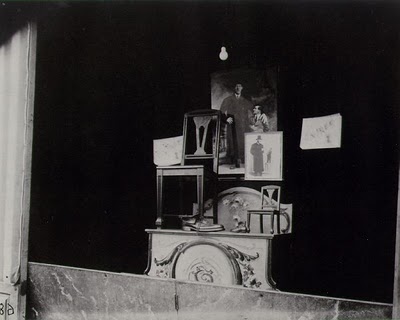
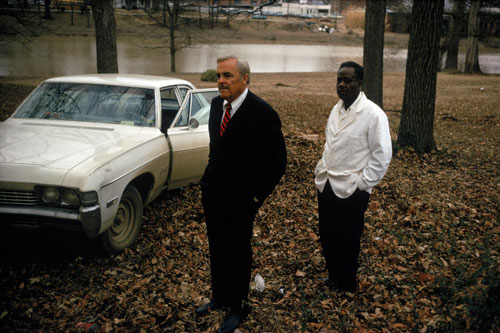
Don’t discount the role of titles & captions, either. This is Atget’s “Fete du Trone,” at the Art Institute.

Audience Feedback

Who is your audence, your clientele? Whom do you wish to engage, or to impress?

Your friends? Your teacher? Your best friend, or your potential best friend?

Who, or what, inhibits your work? What pictures would you make if you knew certain people would not see them?

Who gets to be your primary critic?

http://www.ianaleksanderadams.com/blog/my-mother-writes-on-gray-days/

Who Said This?

“I believe that the alchemy of light on film informs a kind of content that is not remotely duplicated by electronic imaging systems. These systems transfer information with great precision but a silver gelatin photograph transcends the subject and leads one into much higher levels of content. For this reason the photograph per se remains firmly positioned in the social aesthetic matrix.

“The exact same is true of the photography book. Issues such as tactility, luminosity and rhythm on the printed page are not in any way equaled by the image on the digital display.”

Anyone, anyone? Here’s a clue:

AIC Be Free

…for all of February! Don’t forget: the major William Eggleston exhibit will be open the last weekend of the month.

Spotted From A Mile Away

I open the Sunday Magazine; there’s a piece on Fred Hersch.

There is no doubt whose photographs accompany the text: a certain Mr. Lee F.

http://www.nytimes.com/2010/01/31/magazine/31Hersch-t.html?hpw

How Very “AP Apropos”

http://prosedoctor.blogspot.com/2010/01/explaining-your-project.html comes along just as we are working on current drafts of the commentary for the Concentration section of the AP portfolio; how fortuitous.

20×24

Proof


Here is Tod Papageorge’s recent explanation of the relation of photographic picture-making to other creative activities:

“Photography is of course an analytic, not a synthesizing, medium: photographs are commonly produced all-at-once, as light strikes a piece of film. This is unlike the other visual arts, where paintings and related kinds of pictures (including the most rapidly sketched drawing), are built through a process of accretion, stroke by stroke. Writers, too, even the most fluent, parallel these synthesizing procedures as they shape their texts one draft after another, but their practice at least suggests that of photographers, since it involves, in part, an editing process applied to words — and, by extension, to the things that words signify. As W.H. Auden put it, ‘it is both the glory and the shame of poetry that its medium is not its private property, that a poet cannot invent his words,’ an observation also true when applied to photography and the photographer’s inability to invent his “worlds.”

“But where a poet combines, over time (be it minutes or years), the words of a shared language to make a poem, a photographer combines, instantaneously, a jumble of things ‘out there’ (which often share little more than their adjacency) to make a picture. Individual photographs, then, are less like poems than unique ideograms, or picture-complexes that freeze the moment when the objects, air, and dimension framed in a viewfinder are incorporated and fixed together in an unalterable mix by being exposed on film. Because any shift of lens position or subject or light (to say nothing of the camera operator’s concentration) irremediably changes the picture the photographer will make next, his only strategy for clarifying or amending his thinking is to yield it up to making yet another exposure, and, as he does so, to add to an unseen store of images. Unlike the artist or poet, who can revise a given work without accumulating a series of physically distinct versions of that work equal to the number of changes made to it, the photographer builds just such an archive simply by photographing.”

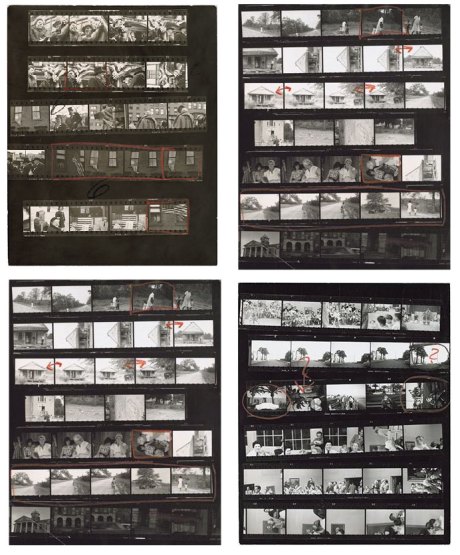
The role of contacts (proofs) in picture-making is substantial; those who are out of film look back on what we do with a hint of nostalgia. Enjoy this summary of the recent exhibit at the Whitney:

http://www.slate.com/id/2236088/slideshow/2236648/fs/0//entry/2236649/

The Contact Sheet, by Steve Crist, is another worthwhile overview:

http://www.ammobooks.com/books/contact/

Lastly, in the era when just about everyone dropped film off at the drugstore, “Photo Finishing” was the term that described enlarged printmaking done commercially after the making of the negatives.

Post Script: The first time I encountered the noun “slide” was as a pre-pube science geek: I built a collection of slides, which are the slivers of glass that support whatever is being viewed through the lens of a microscope. Likely, when illuminated projection of images (on glass) became a medium of presentation, the term was transferred to photography. Now the word has carried over to screens in a PowerPoint presentation.

Samples

http://apcentral.collegeboard.com/apc/members/exam/exam_questions/2134.html will show you sections of admirable portfolios from the past few years. You can see Quality samples, Concentration samples and Breadth samples, and read Commentaries and rationales for the College Board scores, scoring guidelines and more.

  • Calendar

    • May 2026
      S M T W T F S
       12
      3456789
      10111213141516
      17181920212223
      24252627282930
      31  
  • Search