Regarding Our Intelligence

Here is a substantial excerpt from Mr. Mayhew’s Honors course “Writing Jazz” blog:

“Intelligence, in any field, is driven by the desire to discover the inner logic of things, how things work from the inside out. Education, even at the highest levels, tends to emphasize the acquisition of knowledge, but erudition is not intelligence.

“If you take an approach to learning that is oriented toward discovering how things work, you will acquire a lot of erudition along the way, but, more importantly, you will develop real intelligence, which I define as the capacity to draw connections within and between complex systems.

“In some sense the knowledge (erudition) is the easy part. For example, if you asked me analyze the rhythmic interactions between Paul Chambers, Philly Joe Jones, and Red Garland in the Miles Davis quintet rhythm section, it would be very difficult. It would require a lot of close listening and analysis… Jazz provides a good opportunity to exercise this kind of intelligence because of its complexity and subtlety. Since jazz is already a complex musical style, and takes place as one part of a complex culture, then interpreting its place within culture involves relating two complex systems to each other.

“Now I think you’ll say that to this you have to be very, very intelligent… I would put it another way: the way to become intelligent is to do things like this. This shouldn’t really be a wholly new approach for you. I think good students figure this out for themselves eventually. Sometimes very intelligent students, however, don’t really get it. They still think of education mostly as acquiring knowledge and doing well in classes rather than trying to figure out the secret logic of things.”
(Who was it who referred to revealing the hidden structure of things? Metzker? Naw. G. Spencer Brown? Nope. It’ll come to me… Anyway, the point is — one of the points is — that we get smarter through the doing. We don’t need to know what or how before we start out on something, but rather at the middle or the end (ideally; no guarantee, of course). Ah, it popped into my head: the hidden structure quote might be from Emmet Gowin, in the video we have and will likely watch in class soon.)

Matthew Woodward: Bare Ruined Choirs

Go to the Barrington Area Library right away to see the exhibit of Matthew Woodward’s drawings, because you’ll be revisiting before it all comes down on the 20th. Look around carefully so you don’t miss any of the pieces. There are parallels to the kind of monochromatic printmaking that we do.

The library’s website says:

“Through Woodward’s medium of charcoal and graphite on paper, he highlights interesting motifs found on century old edifices. By selecting architectural details from cornices, doors, and gates, he captures a misty beauty of ghost-like finials and creates hazy, haunting, compelling images.”

In between visits, read John Berger’s essay “The Company Of Drawings” in this month’s Harper’s magazine. Here’s a little quote (which happens to begin with a clear similarity to camerawork:

“Drawing now involves subtracting as much as adding. It involves the paper as much as the forms drawn on it. I use razor blade, pencil, yellow crayon, spit. I can’t hurry.”

Assessment Criteria for This Semester

(Yes, this chalkboard picture is meant to segue from the above post.)

In an effort to broaden the six-point system for projects last fall, here is a list of criteria that earn 3 points each:

Film & Contact Sheets: making well-exposed and developed negatives; making correct and useful proofs.

Following Directions: using the assigned set of concerns to shoot; observing deadlines.

Interpretation: going beyond the letter of the law, trying stuff to see what can resonate for the viewer.

Printmaking: exercising one’s craft to produce engaging pictures.

Late or incomplete work at a given deadline earns no credit; reassessment may occur, but is not guaranteed.

Decisions & Resolutions

The phrase that’s been sticking in my rostromedial prefrontal cortex lately is “Prioritize heavily.”

http://calnewport.com/blog/2010/01/29/an-argument-for-quitting-facebook/

Next Year’s AP Roster!

Congratulations to next year’s new members of the

Advanced Placement 2-D Design class:

Annabel Perry

Ben LeCompte

Brianna Yeargin

Caitie Dawson

Chanelle Biangardi

Christina Buerosse

Corey Nguyen

Emma Haney

Erin Dalton

Hailey Anderson

Hailey Featherstone

Jamie Gray

Kulsoom Jafri

Michael Cygan

Michelle Henneberry

Nicole Galanti

Tara Grundy

They join returning artists Kristin Kuhn,

Maggie Kramer, Molly Hendrickson,

Olivia Kottke, Susan Listhartke,

and Zach Schwermer. Welcome in!

Macro/Micro

For the Art Department’s annual theme show, the game (in our medium) seems to be all about scale, and relationships. Some of the pictures may create a seemless illusion, but there is something also to the idea of revealing one’s methods and intentions as one goes.

One scenario: blow up 20 or so balloons, and present the record of it all as salmon roe on top of sushi. Sounds lame, I know, but this is not the medium. The first concern is how it looks.

Today’s example was to photograph a toy marble with a canteloupe. They can be shown one in front of the other, overlapping, or side by side. The lens could be at table-top level in order to compare the orbs’ height. The frame might be placed so tightly that the entire melon does not fit into the frame (implying a kind of enormity). Strong sidelight, directed just so, could cast an elongated shadow from the marble. All of these strategies would simply come across as exercises until you push the situation to a new extreme.

Allen Ginsburg was fond of saying “First thought, best thought.” That’s a good intuitive approach for a poet; a version of that applies to our way of getting into a situation, but it’s in the shooting session that ideas evolve rather than executing whatever notes one jotted ahead of time.

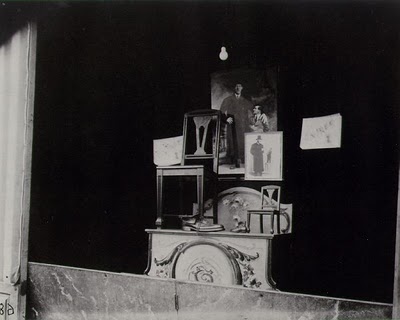
Don’t discount the role of titles & captions, either. This is Atget’s “Fete du Trone,” at the Art Institute.

Audience Feedback

Who is your audence, your clientele? Whom do you wish to engage, or to impress?

Your friends? Your teacher? Your best friend, or your potential best friend?

Who, or what, inhibits your work? What pictures would you make if you knew certain people would not see them?

Who gets to be your primary critic?

http://www.ianaleksanderadams.com/blog/my-mother-writes-on-gray-days/

Who Said This?

“I believe that the alchemy of light on film informs a kind of content that is not remotely duplicated by electronic imaging systems. These systems transfer information with great precision but a silver gelatin photograph transcends the subject and leads one into much higher levels of content. For this reason the photograph per se remains firmly positioned in the social aesthetic matrix.

“The exact same is true of the photography book. Issues such as tactility, luminosity and rhythm on the printed page are not in any way equaled by the image on the digital display.”

Anyone, anyone? Here’s a clue:

AIC Be Free

…for all of February! Don’t forget: the major William Eggleston exhibit will be open the last weekend of the month.