Diary of an Exhibition, Part 3

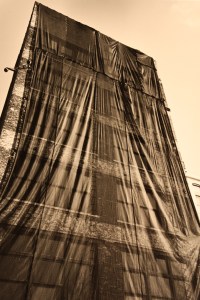
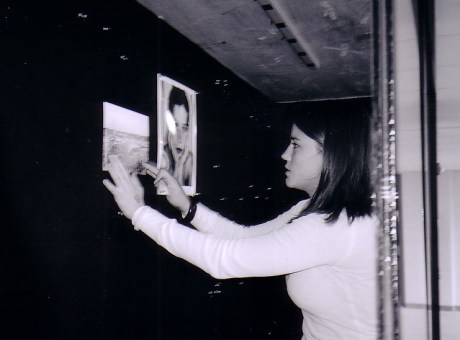
It’s a go. The exhibit of pictures regarding facades will take place at the Barrington Area Library for about seven weeks, from early February to the end of March (into spring break).

A reception is scheduled for the evening of Friday, February 13. Bring yer own cookie.

Will I do a mailing? I dunno. E-mail blasts are effective, but there’s nothing like getting a piece of mail delivered to one’s door. Will there be a related assignment? Prolly, of some sort. Will anything (gasp) sell? Odds are agin’ it; that’s Allstate’s stand.


Digital Submission to the College Board

Every student, parent and teacher involved in Advanced Placement courses may register with AP Central to gain access to their labyrinthine and seemingly endless web site. You could begin at apcentral.collegeboard.com, but also for starters, I think this link will work. Read it and ask/comment.

http://apcentral.collegeboard.com/apc/public/exam/exam_questions/199015.html

Diary of an Exhibition, Part 2

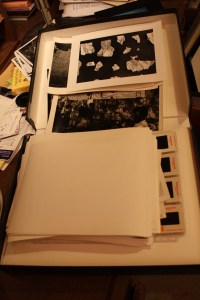
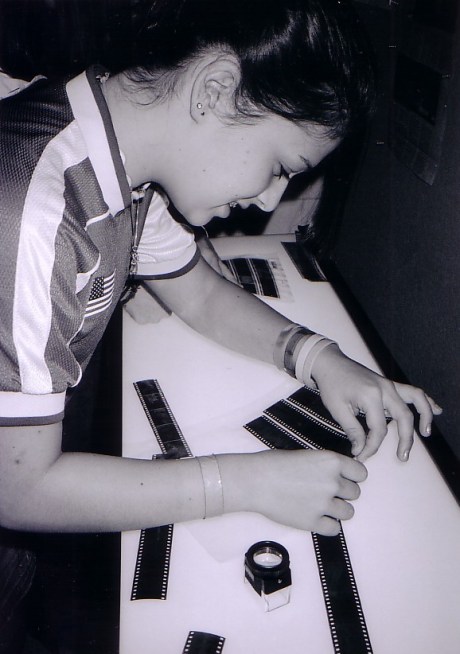
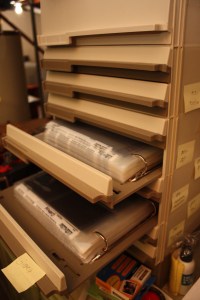
Paperwork, a necessary evil. Wait: nothing about it is actually evil, but it is necessary, just as archiving one’s work is essential. (True, Mario Giacomelli would toss his negatives into a bowl on the dining room table, but few of us want our pictures to look like his.) My contacts are mostly all together; work prints and exhibition prints are currently intermingled, but I can locate a specific negative with astonishing alacrity, and I make that claim modestly.


I was asked to provide a resume, a biography and an artist’s statement. I don’t know of anyone who writes an statement before it’s required. Out of habit, even though I know what and  how to write, I looked for self-help websites and found a ton of ’em. Often, an artist’s statement can be painful to read, especially when they run on, take irrelevant detours or, worst of all, tell the viewer how to look at the work. Artists do not always understand their own work, and what they think of it is occasionally more revealing about them than the work itself is. One option for me was to provide a “bio-statement.” Bingo. Concision. Done.


An inventory of 10-20 pieces submitted for consideration (not the final batch, but certainly representative) needed to have dimensions, titles and prices. The dimensions were incomplete since some of the pictures exist only as work prints. Pricing work can be a monstrous head game; more on that at another time. Titles: yeesh. Don’t get me wrong, I enjoy titling my pictures, and I have two Gemini-style tendencies. Place and date usually suffice without being too clinical, for one. The other is a predilection for cryptic/goofy names. I used to suppress that, but at some point ceramics guru Bob Wilson goaded me into going that route as well.
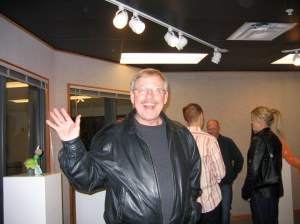
 

                                                                      Bob, by L.D. 


Some of this material got e-mailed to the people who wanted it, and some of it needed to be delivered to the venue, which is local, so I drove it over. Rather than leaving it at the front desk, as directed, I asked for the individual in charge on-site to come out to meet me. This very nice woman explained the entire exhibit program of the venue, took me on a detailed tour of the space, and also walked me through the collection that they own, complete with aesthetic critiques of some favorite pieces. Um, thank you.

Resolution

The first picture of 2009: an omen for the new year?

They just sort of… fell off. (Now, not surprisingly, they’re cleaner than they’ve been in a while.)

The goal, then, can be not to miss a day of photographing.

(BTW, it’s 2256 x 1504.)

“Get gout or get out.”

It’s one of Mr. Anderson’s automatic utterances.


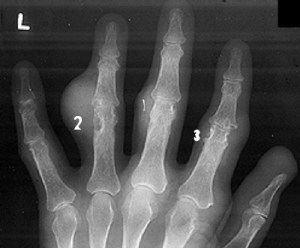
Gout is a very painful condition caused by an accumulation of uric acid crystals in joints, typically one’s great toe. The common understanding is that an unusually rich diet can precipitate gout. A sedentary lifestyle goes hand in hand. I know a guy who got gout: I couldn’t have predicted it happening to him, though. It’s likely that anybody with a condition for which even contact with a bed sheet is painful would prefer to remain housebound, hmm?


 Funny, I’ve never heard of a photographer “developing” a case of gout.


Everybody needs to get out more. You think you’re active and you hit all the hot spots, but that M.O. doesn’t necessarily guarantee better results photographically. Maybe an occasional vacation is your occasion for shooting, but that’s perilously close to what Stieglitz scorned when he referred to “Sunday photographers” over 100 years ago. Yours truly has difficulty shooting at baseball games and jazz performances, because his attention is divided. It’s probably human nature to dismiss unsatisfying results because, hey, we were doing other stuff, enjoying other activities simultaneously.


Let’s be honest: the only promising modus operandi is to step out specifically to make pictures. The only companions (who likely) will not sabotage the day are those who either are also shooting, or are extremely empathetic.


The biggest current challenge, however, is the climate. Maybe this is an inappropriate time to bring it up. More on this anon.


Featured in the Front Hall

Nobody’s noticing now, but when we all return next year (next week) check out the work on display in the Voluminous Cases by (in no particular order):

Andi, Taylor, Chris, Jaime, Amy, Aimee, Claire, Ryan, Ryan, Ryan, Ryan, Ryan, Ola, Liz, Katie, Stef and Delaney.

Be sure to comment on the pictures here ASAP!

Diary of an Exhibition, Part 1

I was approached about putting up an exhibit in two or three months’ time. My natural inclination is to gauge the time available and then prepare mentally for the crunch time closer to the end. But in a recent effort to mature proportionately to my age, I keep mentally reviewing all the things that could go wrong with that scenario- effectively frightening myself into action.


I considered three themes, for any of which I could approach thirty pictures: street shooting, “foliage,” and walls/surfaces. I leafed through box after box of prints that had been sorted according to a different criterion every time I opened them over the years, pausing to greet old friends among them and, more than I care to admit, muttering “I made this? When?” I settled on Facades as a theme.


The easiest way for me to look at them all together was to shoot pictures of the prints, without film. Then I could make 3 categories: Yes, Maybe and No. Some images were briefly eliminated because they had been displayed recently, but they’re good ones, and they fit the group (and that idea never inhibited my curatrix, so why should I worry?).

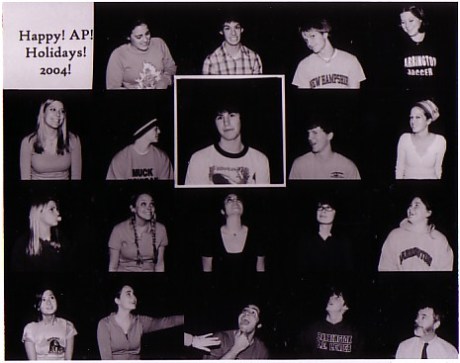
2-D AP Roll Call

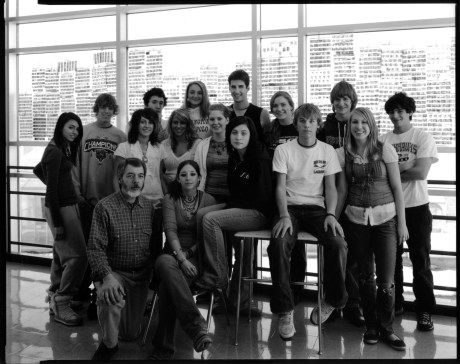
Over the previous seven years of the existence of “AP Photo” exactly 80% of the 70 seniors scored above average (5 or 4); that’s far above the national average. Only one student in all that time has not received a score qualifying for college credit, and in only one year were there no top scores. Other than the first year (which comprised only three students and was not its own section and class period) 2008 matched the previous highest average score, but with twice as many participants.

As a high school sophomore or junior, you can apply to be part of next year’s Advanced Placement 2-D Design class to earn College Board credit applicable to your undergraduate transcript. Watch for details relating to registration; talk to your art teachers about which of the three design courses is best for you, and about helping you to apply.

I see ICCI, si?

The second annual Interstate Creative Camera Invitational is coming up faster than anyone could reasonably anticipate. This year the entrants are encouraged to relate their work to the theme “Multiples,” calling attention to the medium’s ability to reproduce an image any number of times (infinitely, in theory), and to alter the same image in a variety of ways (or not). Get ready…

everybody, Hey!

Welcome to our humble web log dealing with tonal manipulation. Bookmark this joint and stalk it diligently.

The photographers whose work is currently on display in the massive BHS cases want to hear from you. Please respond to their work by commenting here with compliments, yes, but also with questions and whatever connections that happened in your head when you saw the work. Ideally, the photographer will answer your comments as well.


The work is changed irregularly, but not infrequently, so go there now, today. Display of visual art is an inherently passive offering, so you need to take up the apparent slack. We see people gathering and talking about the pictures every day; here’s a way to tell the artists what you’re saying.