Own This Print


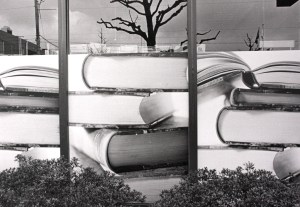
KyotoStoreTo request the above photograph:

Send an e-mail (subject: Limited Edition #090814) to jdionesotes@prodigy.net with your name and mailing address.

If you are the first person to respond after the posting, you will receive the photograph via snail.

Update: this picture has been claimed & shipped.

Insights

The Catherine Edelman Gallery has incorporated video/audio statements from photographers who are included in its “The Chicago Project III” exhibit. Enjoy them all (and more, if you dig a little) at http://edelmangallery.com/currentshow.htm. They are, shall we say, elucidating. If you watch only one, dig around the web site to find Jed Fielding, whose pictures of blind Mexican children some of us saw together at the Cultural Center, last April.

“Artists are workers.” -Cecil Taylor

Evan Mirapaul, over at http://fugitivevision.blogspot.com/, had a perceptive comment about Ray K. that deserves repeating.

“How Mr. Metzker organizes space is manifest in a multitude of materials that crop up decade after decade. We see chain link fencing, stairs, bricks, and the geometry of dozens of city views rendered again and again into an abstract cohesion in his viewfinder. It seems that one could organize a show just of his use of fences. Examples from every series (except the landscapes) come to mind. I posited to Ann Tucker that a difference between Harry Callahan and Metzker is that Callahan is almost always more in close and tight; the figure is more personal, while Metzker takes the more distant, objective view. She replied that she thought that Callahan was about the figure represented in a cityscape, while Metzker was more about a cityscape with a figure or figures included in this view; a subtle but important distinction, I think, especially since, even now, people conflate the student with the teacher.”

It behooves us to keep this distinction in mind the next time we work on Metzker’s (and Callahan’s) turf, the Loop, during our field trip.

“Continuing the musical metaphor, I am reminded of a quote by the French conductor and composer Pierre Boulez. He said that, after twenty years, he was finally beginning to be spontaneous. This is not a comment on stiffness and lack of inspiration: it’s a paean to the creativity that comes from discipline. If you work and work and work, you become so entwined with the material that real improvisation is possible. It’s fashionable to just ‘let it all go,’ or ‘just go up and jam,’ but this approach rarely yields true creative fruit. The best jazz artists, indeed artists in general in my view, find spontaneity from a rigorous work ethic and a strict intellectual foundation. I see this in every Metzker photograph. He is a WORKING photographer. That he can riff on his blacks, or his whites, or fences or cityscapes comes from the foundation of a language rooted in visual philosophy. By taking pictures and working in the darkroom non-stop he anneals this language into a body of work that speaks in every picture of inspiration and freedom.”

SoFoBoMo, fo’ sho’

28L

National Novel Writing Month, or NaNoWri Mo, is a non-competition, a challenge to oneself, wherein writers work to complete a 175-page, 50,000 word novel in one month. It’s an up-front admission by that organization: “Make no mistake: You will be writing a lot of crap.’ The fo-do version of this is Solo Photo Book Month, wherein workers make a virtual on-line “book” of at least 35 pictures inside 31 days.

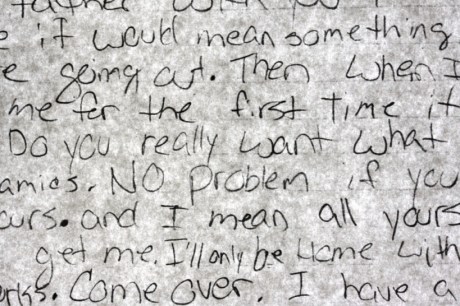
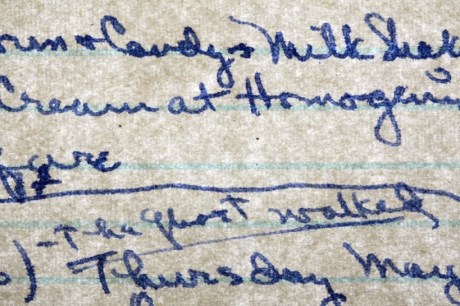
Scraps of paper have been piling up all around me for decades. Since I’ve never had a cigarette, this has not been much of a hazard. Everything seemed to have pictorial potential: notebooks, hand-drawn maps, found notes, anonymous grocery lists (someone has a website of these; hell, that can be said about everything), signs I’ve appropriated (Walker did it too). Keeping in mind the dicta of Garry Winogrand — “Any and all things are photographable” — and of Harold Allen, that what matters is where you put the camera and where you place the edges, I plumbed my archive and plucked pix thereof.

Ray Metzker speaks of working from a set of concerns, and that’s what happened with this little project. In no particular order, there was the texture of the surfaces, the limited (but real) color palette, regard for “horizon” in each image, the writers’ script, their legibility, and the words themselves.

Because I have attained certain level of cyber-capability (just enough), and working under their deadline, the display of the images isn’t what I envisioned (double-page spreads, blank pages as caesurae). If (when) this appears as a hard copy through blurb or whatever, those and other issues will get resolved to some degree. “Writing” is rewriting.

Most of the other 221 completed books employ more traditional / expected / pictorial subject matter, and may be easier to take at first viewing than this subject matter.  Please offer me some feedback on this experiment; thanks.
35R

http://sofobomo.org/2009/books/jdionesotes/content/

Oh, we could quibble…

This rambling list is a hoot. A number of the “tips,” however, look like terrific picture-making strategies if they’re done with clear intention. Feel free to chip in with additional items, to extend the list.

http://gawno.com/2009/05/78-photography-rules/

Hoax is such an ugly word.

What exactly does it mean to you when you’re told that photographers “faked their images?”
http://www.bjp-online.com/public/showPage.html?page=864044

 
Enjoy the “documentary” essay (if you can view pictures in French): http://paiement.parismatch.com/photoreportage2009/unalbum3.php?id=9&ord=9

According to the report, Paris Match has changed the nature of its competition for next year.

I Believe (in) Stephen Shore

Not to put too fine a point on it, but this is currently the most nourishing video piece available to you:

http://www.youtube.com/watch?v=6m5flmLiEDA

Also: look for, covet, and acquire ” The Nature of Photographs” by Stephen Shore. Thank you, and good night.

SoFoBoMo

You can make a book, and you should make a book, and there is a structure within which you will make a book: it’s Solo Photo Book Month, a variation of a similar activity for writers, wherein willing participants “make” a book of photographs (at least a PDF version) of  at least 35 pictures, during a 31-day period between May 1 and June 30.

http://www.sofobomo.org/2009/

Take a look at the previous efforts and the perameters for your project, and I think you’ll want to register for your own project. Let us know about your registration/commitment.

214’s Classy Affair

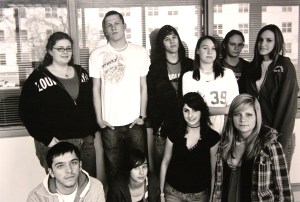
Earlier this month I had the pleasure of conducting a colloquium at District 214’s Film & Photography Day. The annual event has matured nicely into a substantial affair: there was a keynote speaker and 10- count ’em, 10- workshops. Art students were transported from many, if not all, of the high schools in the district.

When Ms. Schrenk of Elk Grove (BHS Class of 1997) asked me what I would like beforehand, I suggested that people bring one of their most recent successful pictures, as well as a picture they admire from wherever else. She told me that attendees did not pick their day’s activities in advance, so that wouldn’t work. Oh, well; I could still address issues that affect artists over the long term, which was my intent anyway, because I need not reinforce the egos of those who skim the surface of picture-making, but rather I prefer to talk with people looking for a way to make a commitment to their work.

The title of my workshop was “Your Place in Photo History,” intentionally adult/stuffy, but what chance does it have when the adjacent one on the list was “I’m Going to Scare the Pants Off America”? In addition, the speaker standing next to me, Ms. Price of BG, dealt with (totally non-threatening) toy cameras! Still, enough people signed on with moi to make for nice cozy groups.

At lunch (EXcellent food, Smithers), we were treated to classic cartoons. The gentleman (eerily evocative of Jeff Albertson [look it up]) who presented the films of William Castle (the “scare the pants off” quote was from him) showed us the first-ever cartoon “Gertie the Dinosaur,” drawn entirely by hand; the not entirely PC “Steamboat Willie;” and two Daffy Duck pieces, one self-referential and one a Cold War allegory.

Ms. Schrenk and I exchanged work afterward, which made my day. That, and I noshed with a girl named Batavia.

If you’re pictured on this post, send me a postcard at BHS, 616 W. Main, Barrington 60010 and I’ll send you a print.

Summer School? Summer School!

Sometimes it seems as though every activity, every event that has been rewarding – field trips, Big Print Days, exhibits, whatever –  has occurred outside the normal bell schedule of the school. That’s because, like baseball and (I’m told) golf, things don’t happen according to the clock. So it is (or feels) with summer school.

Photography in summer school absolutely rocks. The sun is up when we begin, so there’s the free Vitamin D; we ignore the suggested break schedule in favor of going with the flow of the processes; every day is equivalent to a week of regular school; no other class is using the photo rooms, so essentially we take over; a field trip can take place at a smaller, more selective location; what’s not to like? Some people start in the darkroom, some continue, and some work on portfolios.

Photography has now been added to the offerings during the first session of summer school this year. If enough people register it’ll happen; it might fill and close, too. Think about it (but not for too long). Registration may be done online.

  • Calendar

    • December 2025
      S M T W T F S
       123456
      78910111213
      14151617181920
      21222324252627
      28293031  
  • Search