“Positive” Paper

We print from a negative and the print is positive, right?

We print from a color negative and the print is positive; we print from a color positive (a “slide”) and the print is still positive.

If we use b/w paper in a pinhole camera, we get a (contrasty) negative print; most often, we contact-print that paper negative, in order to generate a positive print.

Paper designed to make a (positive) print from a (positive) color slide, placed in a pinhole camera, would make a unique positive print, right?

OK, now dig this: http://harmantechnologynews.com/2IQ-4GVU-77VU59V96/cr.aspx

… and this: http://www.ilfordphoto.com/Webfiles/2010421151622042.pdf

… and this: http://www.freestylephoto.biz/22252-Fotokemika-Efke-BandW-Positive-Paper-RC-Matt-5×7-25-sheets

Polywarmtone

…was a beautiful paper made by Forte, in Hungary, up until a few years ago. Now, a group of investors in working on resurrecting it, in the manner of The Impossible Project (Polaroid’s reincarnation). Here’s the latest:

“The unusually harsh winter in Germany delayed plant construction but last week the concrete was poured for the second story of the confectioning building and plant machinery should move up there soon. The original PWT emulsion kettle from Forte has been scaled down and refurbished.”

http://www.polywarmton.com/index.html

We Love Our Work

April is the coolest month. Here are all of the important dates I can think of at the moment:

3/29   The darkroom is available from 6:00 to 8:30. Sam Thorne perfects time travel.

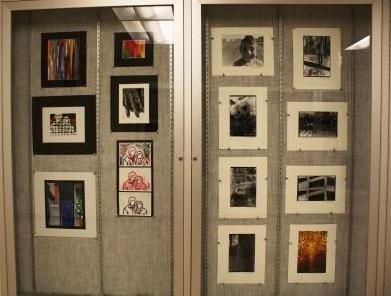
3/30   Your field trip form is due, signed by all, with $6.00 for the Yellow Safety Bus; we hang the AP Seniors exhibit.

3/31   Your field trip form is due, signed by all, with $6.00 for the Yellow Safety Bus; we tweak the exhibit.

4/1     Your field trip form is due, signed by all, with $6.00 for the Yellow Safety Bus; AP exhibit reception, 6:00-7:30.

You should host your own reception, and invite others to share in the celebration (at least one adult and one peer).

4/2    Classes are not in session.

4/8    We embark on the last en masse shooting trip of the year.

4/12  7th hour, the class meets in a library computer classroom in order to set up College Board accounts online.

4/13  We make up the aforementioned expedition if it was postponed due to acid rain.

4/15  Those of you who can spare the time away from class join next year’s class members on a trip (via RR) to galleries in and around downtown.

WWWHO? (What Would Werner Heisenberg Observe?)

http://blakeandrews.blogspot.com/2010/02/filmy-bubble.html

…and what’s your perception of the status of the medium, in and outside of class? There’s an assessment happening every week, the Warman & Godden version being the latest report.

Follow the links; the most telling comment might be the middle sentence of David Bram’s reply to Jake Stangel. I usually ignore comments on other people’s posts, but this one hits the nail on the head for me.

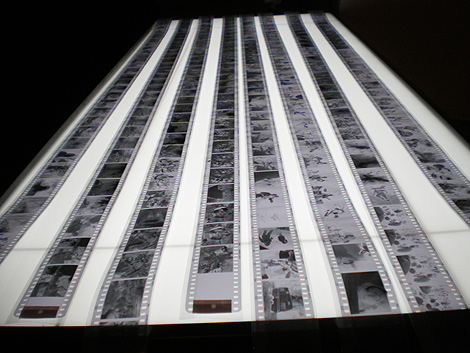
Contact Sheets, Made by You

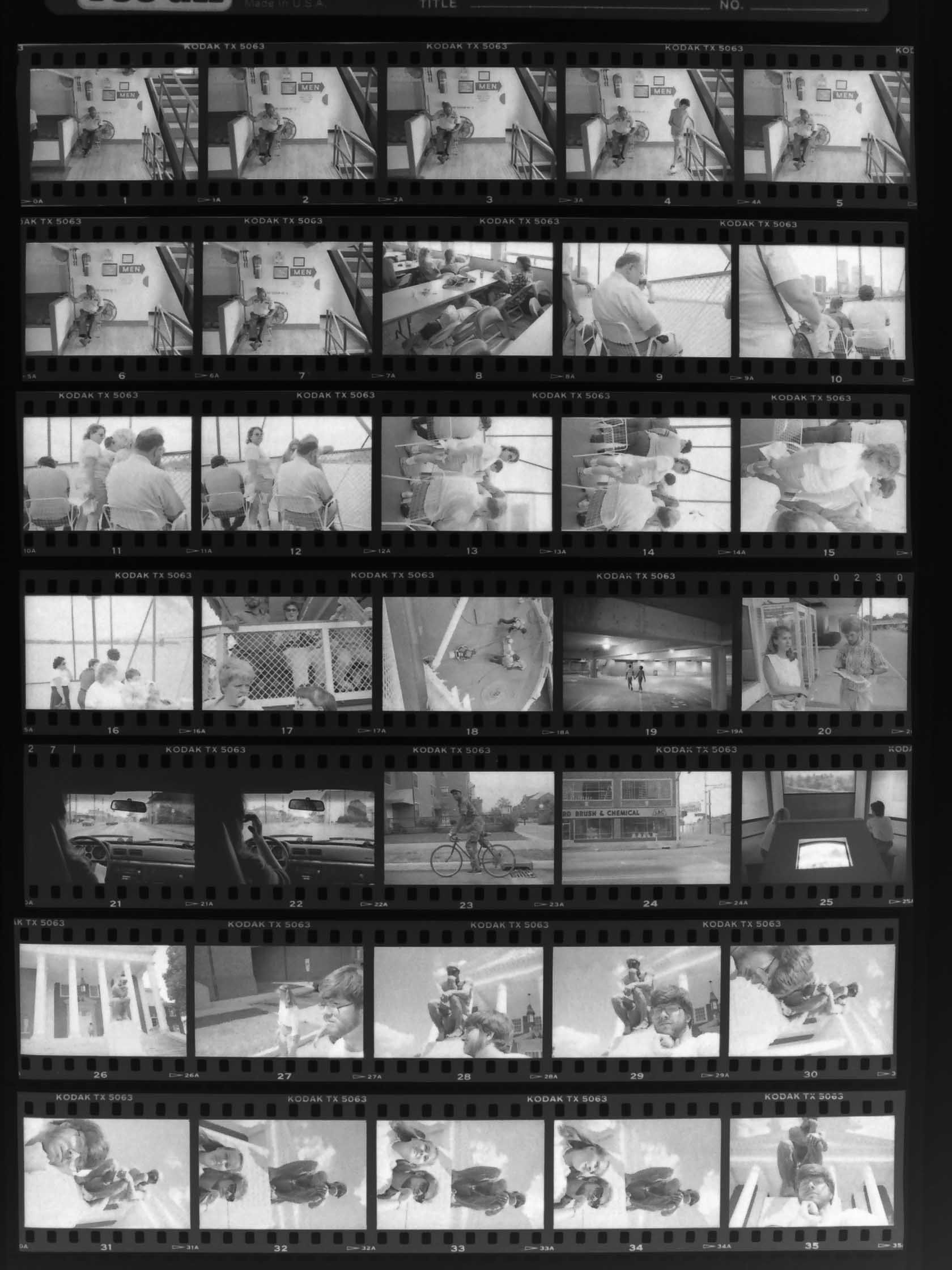
A contact sheet (aka proof sheet) is indeed a photograph, and needs to be considered seriously as such. It’s information about the negative.

In our darkroom, we recommend making a contact sheet without a filter that would modify contrast. Set the enlarger height to illuminate one of our 9×11″ pieces of glass, with a negative carrier installed. Expose through the glass, through the negatives, onto the paper for nine seconds at f11 (f8 if the developer concentrate calls for it).

Some folks (Mr. Winogrand was one) prefer to make proofs at contrast grade 1, reasoning that they can see better into the highlights and shadows. Consistency is key here.

Stock Solutions & Capacities

One of the regular PhDs, “Eli,” writes:

“I purchased 5 gallons of Dektol developer, but it didn’t come with clear directions. How much do I mix for a use of a day? I also have Ilford rapid fixer, 1 liter. I need help/directions for diluting both. I would appreciate your help/input. Thanks!

PS. Where/how can I dispose these chemicals?”

Well, Eli, the standard dilution for Dektol is one part stock solution to two parts water to make a working solution, e.g. 10 ounces Dektol and 20 ounces (tap) water. That can be altered by you in order to affect contrast in the print: 1+4, for example, might help a negative that needs a (mythical) 3 ¼ filter. This developer throws a little sludge in the tray with use, and it’s no problem. The working solution does not last overnight for a second session.

Mix the powder in about 4/5 the eventual volume with around 100 F. water, and finishing the correct measurement with cool water. The stock solution keeps best in brown glass bottles, or opaque plastic away from the light. Kodak’s standard statement regarding storage of liquid developer concentrates is that they keep reliably for six months in full closed containers, and two months in partially-filled containers.

Rapid fixer is commonly diluted 1+7 in room temperature tap water for fixing RC paper. For a long time, I’ve been diluting the Kodak Rapid Fixer in Barrington Huge School darkroom at the stronger 1+3 dilution for a variety of reasons (occasional fiber paper short times to match RC; exhaustion insurance; unreliable fixing habits endemic to adolescence). Count your prints and test strips to ensure good fixing and to avoid overuse of the batch; I recommend 40-50 8x10s per liter for your darkroom (see http://www.emsdiasum.com/microscopy/technical/datasheet/ilford/paperchemicals.pdf to know why). I save the used fixer for regular trips to the IEPA drop-off in Naperville: http://www.epa.state.il.us/land/hazardous-waste/household-haz-waste/hhwc-schedule.html

Film Speed Testing

If you are having problems with exposure (if a significant percentage of your negatives are either very dense or very thin, or both) it’s time to break your habit of buying and ruining film. Here is a reliable way to determine your own personal exposure index for the film you use, and for the way you expose and develop. Kodak devised a “ring-around” test which is more specific than this version; I have used it and benefited from it, but I think the version I describe here will be enough to tell you what you want to know. Essentially, you shoot the same scene at 3 different film speeds, develop each set at 3 different development times, and pick the best result.

***Use the lens you use most often and use one common shutter speed for all the exposures.

***Make a scene that is in part sunlight and part shade. Assemble a collection of well-known items of differing textures and colors. Place some glass, some wood, and some cloth in the scene. Be sure to get something dark and something light. Place things in the shade and in the sun. Also, place a standard gray card in the scene, in direct sun, and make sure that the card has no reflection, so that it represents neutral gray. Find a person to include in the scene; you can be your own model (use your timer or a long cable release). Take all the photos in a quick succession, so that the light is the same for each photo. If you want to test indoors, you can do that if you must, but you really want to test a natural scene, and come up with the film speed & developer time that looks most like natural light.

***Get some pieces of plain white paper and a broad-tipped marker, and make a set of 3 labels. For example, let’s say we are going to test 400TX film. Make a label that says “400TX”. Another will say “TX800”. Make another that says “TX200”. Make sure that the lettering is large, so you can read them when you make prints.

***On a roll of 24 exposures, set your light meter to a speed of 400 and take a reading from the standard gray card. Let’s say you get an exposure of 1/250 second at f/11. Place the label that says “400TX” in the scene, in a prominent location. Shoot a frame. Now stop down the lens by 1 stop, to f/16, and replace the label with the one which says “TX800”. Shoot a frame. Now open the lens to f/8, and replace the label with the one which reads “TX200”. Shoot another frame. Skip over 7 or 8 frames and repeat the exposures. Once more, skip 7 or 8 frames and finish the roll with a third set of test exposures.

We now have 3 sets of shots: one set for each film speed. We want to cut the film in the dark into 3 strips, and develop one strip of the film from each set for a different length of time. If we are using a developer whose recommended time is 10 minutes at 70 degrees, let’s develop one set for the recommended time of 10 minutes, another set for 8 minutes, and another set for 12 minutes. In the darkroom, make a set of contact prints on multigrade paper with no filter (or Number 2 paper), giving just enough exposure for the clear film edge to be as black as the paper allows. Use fresh chemistry, and develop each sheet for the same time, such as 2 minutes in LPD. Make a contact print, not an enlargement, because you want to eliminate the effect of the enlarger and the enlarger lens. It’s likely that your enlarger has a condenser head (a collimated light beam), meaning that high values could be blocked due to the Callier Effect.

Find the image which feels the most like light, throughout the entire range of tonality. You want the shadows to be dark, but still contain sufficient detail. You want the high values to look clean and white, but still have some texture. You want the model to look like a human. You want white paint in the sun to look like white paint in the sun, not bleached out. Gray clothing should look middle gray. That’s the film speed/developer combination you will use for normal lighting, and expect normal results. You will also find that one of the film speed/developing times looks best for a “minus-one” development time: The shadows will be normal, but the high values will still be one stop too low. Similarly, you will find a combination of film speed and development time that works nicely for “plus-one:” the shadows will look normal, but the high values will be a bit too high, by around 1 stop.

With these times, you can handle many lighting situations that arise: high contrast, and low contrast. If you want to perform more testing, you can determine the best times for N-2, N+2, etc. Be aware that when you under-develop film, you lose some speed in the process. So, to follow our example, you might have to shoot TMY at a speed of 100 when you lower the contrast by 2 stops, IE with N-2 development. In the same way, if you increase the development time enough to expand contrast up to N+2, you may need to shoot TMY at 300 or higher. Everything is… you know… interconnected.

You can use this same technique to compare the results of the same film in different developers, or different films with the same developer. They are not all the same. This is not only true in terms of densitometry and science, but subjectively. Some film/developer combinations are gritty, while others are smooth. Some are harsh, others are silky. Find the ones you like most; you’re the artist.

Bottom line, in a pinch: whatever the manufacturer claims for the film speed, just cut it in half. So if it’s T-Max 400, shoot it at 200. If it’s Ilford FP4+, which is rated 125, try it at 64.

Two First-Person Accounts

Here are two photographers’ records of commercial darkroom work, each with plenty of connected texts. Flip a coin to determine whether to read Mr. Luckett or Mr. Steinbicker first.

http://consumptive.org/adjustments/adjust.business.html and http://consumptive.org/adjustments/adjust.grind.html; also

http://lifeslittleadventures.typepad.com/lifes_little_adventures/2006/05/how_we_did_it.html

The H&D Curve: Update

“The question is moot.” -Rev. J. Jackson

A confidential memo has been leaked to me: Kodak discontinued Microdol-X five weeks ago.

The H&D Curve

Wikipedia says “Ferdinand Hurter (1844–1898) and Vero Charles Driffield (1848–1915) were nineteenth-century photographic scientists who brought quantitative scientific practice to photography through the methods of sensitometry and densitometry.”

At http://blakeandrews.blogspot.com/2009_09_01_archive.html  you can scroll down to the September 24 entry for an example of a Tri-X characteristic curve, as well as parodies of H&D curves (fo-do insider jokes). In each case the curve consists of a toe (shadow tonal separation), a straight line section whose angle indicates the inherent contrast, and the shoulder, which refers to highlight separation.

Ms. H. has this bone to pick:

“Jeff,

‘For extra fine grain try T-Max 100 in either Microdol-X or Perceptol full strength. The grain rivals Technical Pan at about five times the speed and no problems with controlling contrast.’

“People were Microdol crazy when I was at school. Is this necessary? Why can’t people just invest in a tripod and use fine grain lowwwwww speed film? Straightforward and simple; slower film=better grain. Are my views skewed? I have always preferred most others over T-grain films- Is it just because my elders told me they were better? I look forward- perhaps this weekend- to enlarging some negatives to definitively answer such questions. Damn it.”

H

You’re right. A slower non-tabular grain film, exposed and processed in another standard developer, is probably preferable to fast T-Max or Delta. I suspect people find themselves in a corner once they’ve loaded a camera. Barrington Huge School standardized on D-76 until I changed it over to Microdol-X for reasons of economy, and of dealing with a host of real and anticipated exposure predicaments. Microdol-X is a fine fine-grain developer, a point which has been moot in the Wonderful World of E274 since XTOL came along. Your views aren’t skewed, they’re based on solid information and good craft.

I was first forced to try Microdol-X around 1976 or 1977 when I visited (out of desperation and a sense of adventure) a rental darkroom somewhere in Oak Park, and that’s all they had (it made me a nervous wreck). I imagine that  you’ve tried your share of formulae. Developers I’ve trusted, and which have rewarded me with excellent negatives over the years, include D-76, Microdol-X, HC-110, Rodinal (everybody genuflect, now), FG-7, D-23, Ethol T.E.C., Acufine, Diafine, D-19, Neofin Blue, FX-1, TFX-2 and PMK Pyro. Each delivered as promised when the film was correctly exposed for the “soup.”

This perspective comes from other e-mail correspondence:

“…there are two quite different films sold under the Tri-X name. One is an ISO-400 film with a medium toe, the other is an ISO-320 film with a very long toe. Both are available in 120 but the ISO-400 film is the only one available in 35mm and the ISO-320 film is the only one available as sheet film. The difference is in the tone rendition. Kodak has made a long toe film in sheet sizes for many years. It has lower shadow contrast and bright highlights. According to the Kodak data sheets its for use in low-flare conditions, i.e., in the studio with controlled lighting and modern lenses. The ISO-400 version is for general purpose use.

“Plus-X used to be the same way, the sheet version was a very long toe film. The tone rendition of the two is not radically different and plenty of people use the 320 version as a general purpose film, however, for some use, especially where one wants bright highlights, it has an advantage. The characteristic seems to be similar to the films sold many years ago as portrait films such as Kodak Portrait Panchromatic. To some degree the difference in tone rendition is evident by overlaying the curves for the two films but you really have to photograph the same subjects and compare the prints to see the actual difference.

“In comparison, T-Max films have relatively short toes, similar to the old Super-XX. The Tri-X 320 film has a curve which is upward deflected all along its length although not quite to the degree that the old Plus-X Pan Professional sheet film was. Note that the current Plus-X is a medium toe film for general use. I must say I think it is underrated by many. A very fine grain film with good tone rendition for many subjects.”