http://www.npr.org/templates/story/story.php?storyId=113692571
…and this’ll be better, because…?

http://www.npr.org/templates/story/story.php?storyId=113692571
…and this’ll be better, because…?
Here is a telling comment from an interview with Richard Benson in LensWork; read the entire piece in class, and refer to our copy of Benson’s The Printed Picture:
“…I think most photographers would like to believe that the thing that matters is the image that they capture with the camera – the thing they do when pressing the button. We actually are now living in a time when most serious photographers even go so far as to have somebody else print their work, which I think is scandalous…
“Photographers too often think that magical thing they do is gather the image in the camera. I think that’s just stupid. I think photography is art and I think a piece of art resides in the physical object made. It’s appalling to think that somebody else can be in charge of physically presenting one’s image on a piece of paper…
“Historically, it seems to me that artists have been the best craftsmen, the best technically at what they do. And I think it’s a great mistake for photographers to think that there’s some pro in a lab who’s better than they are at printing…
“There are photographers who follow the tradition of Edward Weston and work themselves in the darkroom and make great prints. That’s wonderful, and they do just the right thing. In photography in color, which is a very big deal today, there are an awful lot of cases where the work is printed by somebody else, and I just think it’s a travesty. I don’t make myself popular by saying this. I have photographers say to me, “Why should I have to know about that? I have to know about the subject and the frame and all of this. Why should I have to know about that?” Well, dammit, you have to know about that because you’re making a piece of art that you hold in your hand. Let’s not have it made by committee; let’s have it made by one sensibility working at a very high pitch…
“The way you make the print has a tremendous impact on what the thing means.”
And now a related, more succinct comment from an alumna during the field trip luncheon:
“I miss the darkroom.” -Sam Thorne
So. You’re taking a picture of a guy who’s wearing a white shirt and black slacks, and you’re using 400TX or some other film you intend to develop yourself. Typically, you want the most information recorded on the film that you can get, so you’d like to maximize the amount of detail toward both ends of the tonal spectrum (assuming that the midtones are assured, by careful processing). Here’s a strategy that’s better than win/win, if you can believe that.
Set the meter on your camera to 200–half the published ISO; now we call it our Exposure Index, or EI.* This tells the meter that the film is half as sensitive as it really is, so that the meter will recommend a combination of shutter speed and aperture that allows twice as much light onto the film as it “needs.” Now the baggy wrinkles in our model’s (we’ll call him “D”) trousers are recorded more fully on the film. But wait: what about the folds in the shirt? Won’t the white get blown out by overexposure? Au contraire, mon frere. We can use a new, shorter developing time to keep that from happening. Less time in, say Xtol means less tendency for the grains to clump, resulting in slightly less apparent grain; it’s win/win/win!
Here’s a more technical, very clear explanation of the above:
http://www.youtube.com/watch?v=rlnt5yFArWo&feature=related
…and here is a less technical, very unclear version:
http://www.youtube.com/watch?v=VGBXHCGFOgw
*Alternately, for some cameras, set the exposure compensation function to +1 (but never both at the same time).
I don’t want to die:
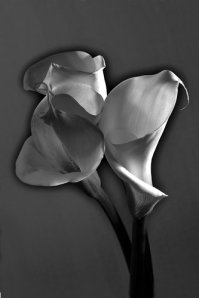
Here is a good starting point, with fairly reliable results:
The Sabatier effect is a style of exposure and development whose appearance is markedly different from “normal” photographic representation. Unlike such strategies as negative prints or the use of camera lens filters, the resulting print is a unique distortion of the tonal scale that does not appear to conform to that of the original scene. What is needed for a successful solarized print is a negative that would normally print well with a #2 or #1 filter (dense / over-developed / contrasty scene), and a #5 filter. The printing procedure that follows is a series of steps that approaches repeatability (although the process is notoriously difficult to control).
Each piece of photographic paper receives two exposures and is developed twice. An acid stop bath would inhibit the second development, so set up an extra tray of plain water for a rinse in between the developments.
Use full sheets of paper to make test “grids” rather than strips. Make exposures for, say, three-second increments at f 8. Develop, then rinse thoroughly for up to a minute; drain, squeegee and/or blot in some combination in order to remove all the water from the emulsion. At this point some images may not show much at all for some exposures. Don’t worry: this may work in your favor when the process is finished. Return the paper to the enlarger. (It is practical to place a sheet of contact printing glass on top of the easel to keep the damp paper from the easel and baseboard.) Make a second series of exposures without the negative (but still with the #5 filter) perpendicular to the first, for maybe two seconds each at f 16, then develop, stop and fix the paper normally.
Examine the grid of to find a combination of exposures you think will work for the image. Unlike traditional representational printing, there may be a wide spectrum of interesting choices.
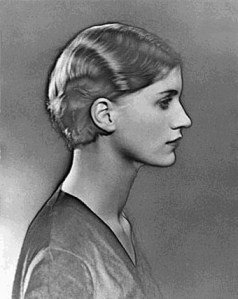
Harman Technology — who acquired Ilford, re-introduced many of their products; who also manufactures Kentmere products and one or two more good brands; and who pledged that they were committed to “analog” photography for the long haul — has been conniving in concert with the Impossible Project! Read on: http://www.bjp-online.com/public/showPage.html?page=867790, and stop weeping.
Some questions:
1. Do you have Polaroid equipment you could resurrect if fresh film became available?
2. Which emulsions have you used & enjoyed?
3. If you have any experience with Fuji instant film, which (if any) make satisfactory transfers?
When I was a short person, I did not yet drink coffee; rather, pots and pots of black tea, and gallons of iced tea in summer. (Note: now it’s “ice” tea, and not because of the performer’s name. Language really does morph. Ice cream used to be “iced” cream, I’m told.) I did not get around to coffee until my late twenties, when I happened to sample un tres bon cafe in Paris. I came back to Chicago, wound (past tense of wend, but only when you’re in a spiral mall) up to the last storefront and whined to Bob Wells, “How can I make coffee like they have in Fraaance?” He pointed to the machines out of reach on the top shelf, machines that ran 500-800 dollars. I wanted coffee that gave the mouth feel of cocoa, but without the sweetness of added sugar. (Plus, coffee does not stain the teeth as badly.)

Junkies wish they could relive the exhilaration of their first-ever high each time they fix (so I’m told). Is it the same for coffee lovers? Maybe. Compare that to your (conscious or unconscious) attempt to replicate the thrill you had when your first good print came up in the developer. Whoosh, right? Just as a film and developer combination gives you a look that works for you, so can a pairing of paper and developer. Here are ideas about commercially available chemistry for your sanctum.
The K.I.S.S. approach to paper chemistry requires only developer and fixer. The standard developer is Kodak’s Dektol, whose advantage is a little contrast control through dilution. It does throw some sludge in the tray with use, however, and one may (will) acquire a sensitivity to the Metol in it over time. Those are reasons I replaced it in the Hah Thkoo with LPD, which lasts longer (get it? “L” PD), has Phenidone instead of Metol, and allows for subtle shifts of print color by dilution (and, of course, choice of paper). It comes as a can of powder to make a stock solution or as a liquid concentrate. At this writing a quart of liquid concentrate runs $13.00, typically to dilute 1:4. There are many, many choices among pre-mixed paper developers, but it’s unlikely to find anything better for the price.
The second tray in printing is usually water with acetic acid, to neutralize the (base) developer on the drained print. This stops the development, hence the term “stop bath,” and prevents that little bit of developer from contaminating the fixer. Kodak has long offered Indicator Stop Bath, which is a 28% dilution of acetic acid (like vinegar, only 5 or 6 times stronger, not food grade, and a bit more acrid one’s nostrils) with a dye mixed in. Two ounces of this in a gallon makes a yellow solution which appears clear under safelights. Once enough prints have neutralized the acid, the dye turns dark (purple) so you’ll know. In the Huge School we set up a larger tray with an overkill of just water (not “just water,” but probably the hardest tap water in the Northern Hemisphere) which does the trick and is easily replaced as the periods pass.
Fixer: simple. Once again, to avoid inhalation of nasty dusty powders, stick to liquid concentrate. Everybody has a fixer for sale. They all work. Our recommendations: Kodak Rapid Fixer, Edwal Quick Fix, or Formulary TF-4. Each runs somewhere from $10.50-12.00 for a quart of concentrate. As with film fixer, count how many sheets you run through a tray of working solution (don’t bother to add the hardener if any comes with it in a separate bottle), and retire the batch before it’s exhausted. The IEPA will receive your old batches from you (talk to me about that).
That’s it. Almost as simple as Edward Weston’s darkroom. You needn’t bother with hypo clearing agent if you use RC paper, nor fiber if you calculate a diligent wash of small batches and sufficient agitation therein. Let’s play it real safe, by you axing me a ton o’ questions afore ye shop.
When I started to print, many good and legendary papers had already disappeared, and in fact were vanishing that very month. I went on a wild goose chase to acquire some DuPont Velour Black; never found any. Ilford’s Ilfomar was still available in Canada, but not for long, either. I suspect part of the Velour allure was/is the same as it is for all things gone: one wants what one cannot have.
The high school used to stock single-weight Agfa Brovira (fiber-based, not resin-coated) in 500-sheet boxes, in all six grades. (There was an elaborate system of distribution and labeling that I swear took half of each class period, and somehow it all worked out.) Every Agfa paper I ever encountered was very good. Many workers swore by the silver-rich Portriga-Rapid, which faltered for a few years in the 1990s which its formulation was made to conform with new environmental standards; a paper not sold in this country, Record Rapid, had such a reputation that I found some on a trip to London; later it was introduced here as Insignia. It was great, but did not age well in the box. Toward the end (of Agfa) their paper of reputation was Multicontrast Classic (MCC). HS Ph.D.s used quite a lot of this variable-contrast, double-weight fiber paper in 11×14 before it disappeared. A friend of mine tried to buy some at Central Camera; the clerk said, “We’re all out. Some guy named Friedlander called from New York and bought it all.” Now Adox is re-introducing a paper called MCC 110, modeled after Multicontrast Classic, and it’s shipping in September.
Not everyone would necessarily agree, but for moi, whatever paper I would try, it seems I always returned to Ilford Galerie, a top-o’-th’-line double-weight fiber paper made in Grades 1 through 4. (I just finished a box of Grade 1 purchased sixteen ears ago; sniff.)
Kentmere is currently part of Harmon (Ilford), and makes very nice stuff. Oriental papers are quite good, and have their adherents. Forte made beautiful papers, and there are rumors of re-appearance. Kodak made Azo, which was contact speed, not at all suitable for enlarging. Typically, I’ll expose it four feet from a 75 watt bulb for around two minutes. Now, two photographers in Pennsylvania have contracted to have a replacement paper made, called Lodima. Lately, folks on the pure silver e-mail thread are talking about good characteristics of Arista II VCFB, calling it the world’s cheapest paper. We’ll have to get some and see for ourselves, right?
For general information on how to choose and use papers, see:
7/22 Update from Dr. Rudman: “Potentially exciting news is about to be released from Harman Technology / Ilford Photo. They will announce their commitment to develop a new Fine Art silver gelatine paper suitable for Lith Printing and toning, which it hopes “will be every creative printer’s dream”. This development is part of their ‘Defend the Darkroom’ campaign, which “aims to safeguard the future of darkrooms and associated creative techniques“. The new product will be a variable grade, double weight, fibre based black & white paper ideal for Lith printing and toning.” Stay tuned for this. To get the e-mail updates from the World Of Lith Printing, which is a unique style of printing with its own darkroom methods, see http://www.timrudman.com/
Bidding begins tomorrow, Thursday, at noon Chicago time.
P.S. The lunar dust brushes right off.
 Creative Camerawork