Polywarmtone

…was a beautiful paper made by Forte, in Hungary, up until a few years ago. Now, a group of investors in working on resurrecting it, in the manner of The Impossible Project (Polaroid’s reincarnation). Here’s the latest:

“The unusually harsh winter in Germany delayed plant construction but last week the concrete was poured for the second story of the confectioning building and plant machinery should move up there soon. The original PWT emulsion kettle from Forte has been scaled down and refurbished.”

http://www.polywarmton.com/index.html

Bust Card

Photographer and attorney Bert Krages has written a clear overview of the legal issues that could arise on, say, a field trip. He offers it as a pdf, as does the American Civil Liberties Union provide their own broader version: the Bust Card. Read ’em and don’t weep: other nations are not so friendly to shooters of film & platers with pixels (see the last url, below). Here are excerpts from Krages’s pages:

“The general rule in the United States is that anyone may take photographs of whatever they want when they are in a public place or places where they have permission to take photographs. Absent a specific legal prohibition such as a statute or ordinance, you are legally entitled to take photographs. Examples of places that are traditionally considered public are streets, sidewalks, and public parks. Property owners may legally prohibit photography on their premises but have no right to prohibit others from photographing their property from other locations.

“Taking a photograph is not a terrorist act nor can a business legitimately assert that taking a photograph of a subject in public view infringes on its trade secrets. On occasion, law enforcement officers may object to photography but most understand that people have the right to take photographs and do not interfere with photographers. They do have the right to keep you away from areas where you may impede their activities or endanger safety. However, they do not have the legal right to prohibit you from taking photographs from other locations.

 “Basically, anyone can be photographed without their consent except when they have secluded themselves in places where they have a reasonable expectation of privacy such as dressing rooms, restrooms, medical facilities, and inside their homes.

“Absent a court order, private parties have no right to confiscate your film. Taking your film directly or indirectly by threatening to use force or call a law enforcement agency can constitute criminal offenses such as theft and coercion. You are under no obligation to explain the purpose of your photography nor do you have to disclose your identity except in states that require it upon request by a law enforcement officer.”

BTW, in the instance of the afore-imagined field trip, it’s a good idea to carry one’s student ID; Chicago has truancy officers.

http://www.krages.com/phoright.htm

bust card

http://www.aclu.org/files/pdfs/racialjustice/rp_bustcard_eng_20090929.pdf

http://action.aclu.org/site/DocServer/kyr_spanish.pdf?docID=186&cr=1

http://photographernotaterrorist.org/

Manna

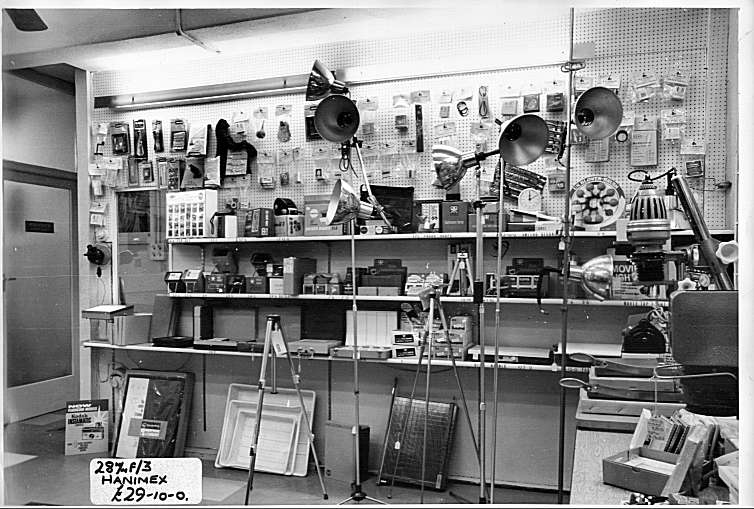
Of late, due to the persuasions of advertisers and the fickle nature of consumers, many of us have been able to acquire quality equipment through closeouts, auctions, estate sales, craigslist, eBay, donations, hand-me-downs, and from little old ladies’ attics (Ah! My Leica!). The details of maintenance and repair, and the availability of parts and accessories, present no serious obstacles; however, make certain that film is currently made in the format that fits your new camera, and give heavy consideration to including in your arsenal a meter, a cable release and a substantial tripod.

(Ahem: wipe the drool from your chin.)

Case in point: Kim Lange, BHS class of 1988.

“Paydirt…2 4×5 Graflex field cameras. A Beseler enlarger. One large and one small dry mount presses. A box of miscelaneous flashes and lenses. A tripod.

Now all I need to do is remember how to shoot, figure out how to set up a darkroom, and purchase the rest of the accessories….oh yeah, and add a few more hours to the day. It is awfully fun to have cameras back in my life.”


Reciprocity Failure

1/30 second @ f4 is the same amount of light reaching the film as ½ @ f16 is, but not necessarily the same as 2 seconds @ f32: it turns out that equivalent exposure, reciprocity, is reliable only between 1/10,000 and ½ second. Usually. Since most of us won’t be dealing with the ultra-fast times, let’s become aware of the longer ones.

http://home.earthlink.net/~kitathome/LunarLight/moonlight_gallery/technique/reciprocity.htm is a good place to look at this because it provides a chart of some recommended corrections. This will come into play for some of us as the weather improves and the daylight extends further into the evening, and low-light exposures become a real possibility.

Another factor in all this is that, for many films, the ideal situation also involves modifying (usually shortening) the developing time to as well, to a calculable degree, and that the film that sidesteps this modification best is Acros 100.

Make Your Own Film!

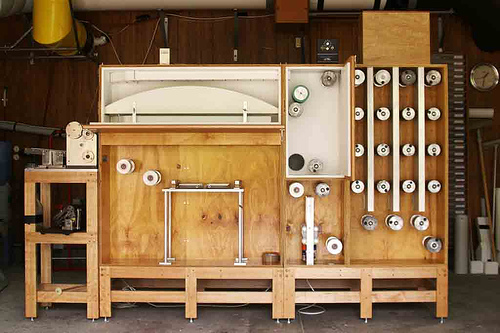
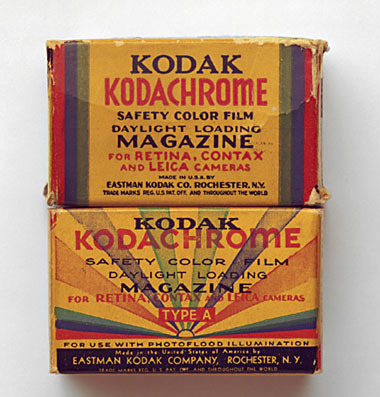
I learned today that Fuji is discontinuing some of its products, including two of my favorite color films: T64, which provided the AP photographers with excellent slides for many years, and their ISO 800 negative roll film. This guy’s contraption is one solution to any shortage of film stock, I guess, but he aims to replicate Kodachrome, of all things! Our thoughts and prayers are with him.

http://www.flickr.com/photos/dark_orange/2042501949/in/set-72157603226919391/

Free Film!

It’s 120; it’s color; it’s as fresh as circumstances allow. The price is right. Again, the line from “The Untouchables” is propos: What are you prepared to do? http://www.aphotostudent.com/2010/03/04/super-great-expired-film-giveaway/

(It’s not that old.)

Contact Sheets, Made by You

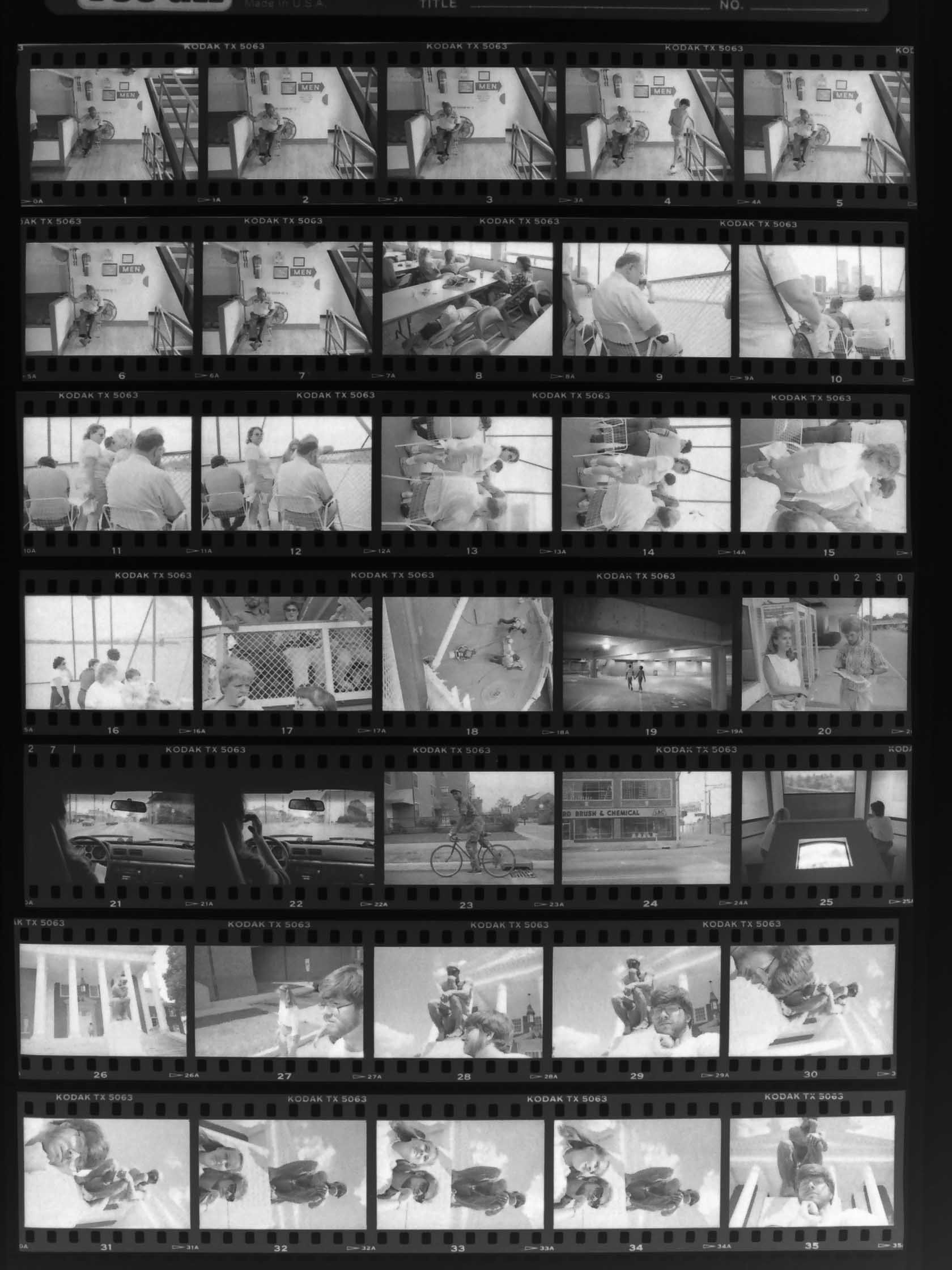
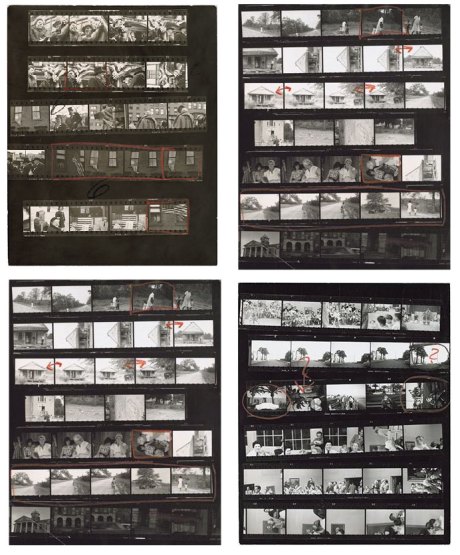
A contact sheet (aka proof sheet) is indeed a photograph, and needs to be considered seriously as such. It’s information about the negative.

In our darkroom, we recommend making a contact sheet without a filter that would modify contrast. Set the enlarger height to illuminate one of our 9×11″ pieces of glass, with a negative carrier installed. Expose through the glass, through the negatives, onto the paper for nine seconds at f11 (f8 if the developer concentrate calls for it).

Some folks (Mr. Winogrand was one) prefer to make proofs at contrast grade 1, reasoning that they can see better into the highlights and shadows. Consistency is key here.

20×24

Proof


Here is Tod Papageorge’s recent explanation of the relation of photographic picture-making to other creative activities:

“Photography is of course an analytic, not a synthesizing, medium: photographs are commonly produced all-at-once, as light strikes a piece of film. This is unlike the other visual arts, where paintings and related kinds of pictures (including the most rapidly sketched drawing), are built through a process of accretion, stroke by stroke. Writers, too, even the most fluent, parallel these synthesizing procedures as they shape their texts one draft after another, but their practice at least suggests that of photographers, since it involves, in part, an editing process applied to words — and, by extension, to the things that words signify. As W.H. Auden put it, ‘it is both the glory and the shame of poetry that its medium is not its private property, that a poet cannot invent his words,’ an observation also true when applied to photography and the photographer’s inability to invent his “worlds.”

“But where a poet combines, over time (be it minutes or years), the words of a shared language to make a poem, a photographer combines, instantaneously, a jumble of things ‘out there’ (which often share little more than their adjacency) to make a picture. Individual photographs, then, are less like poems than unique ideograms, or picture-complexes that freeze the moment when the objects, air, and dimension framed in a viewfinder are incorporated and fixed together in an unalterable mix by being exposed on film. Because any shift of lens position or subject or light (to say nothing of the camera operator’s concentration) irremediably changes the picture the photographer will make next, his only strategy for clarifying or amending his thinking is to yield it up to making yet another exposure, and, as he does so, to add to an unseen store of images. Unlike the artist or poet, who can revise a given work without accumulating a series of physically distinct versions of that work equal to the number of changes made to it, the photographer builds just such an archive simply by photographing.”

The role of contacts (proofs) in picture-making is substantial; those who are out of film look back on what we do with a hint of nostalgia. Enjoy this summary of the recent exhibit at the Whitney:

http://www.slate.com/id/2236088/slideshow/2236648/fs/0//entry/2236649/

The Contact Sheet, by Steve Crist, is another worthwhile overview:

http://www.ammobooks.com/books/contact/

Lastly, in the era when just about everyone dropped film off at the drugstore, “Photo Finishing” was the term that described enlarged printmaking done commercially after the making of the negatives.

Post Script: The first time I encountered the noun “slide” was as a pre-pube science geek: I built a collection of slides, which are the slivers of glass that support whatever is being viewed through the lens of a microscope. Likely, when illuminated projection of images (on glass) became a medium of presentation, the term was transferred to photography. Now the word has carried over to screens in a PowerPoint presentation.

Pinhole Photography

You can make a camera out of a cardboard box easily, in under a half-hour. You’ll need a sturdy box, like a snug-lidded shoebox or an oatmeal box; flat black paint to darken its interior; hmm… maybe I can supply the rest. Watch these:

http://www.youtube.com/watch?v=b4pdY82vjss&feature=related

http://www.youtube.com/watch?v=jeBY18KsaXg

http://www.youtube.com/watch?v=jeBY18KsaXg

http://www.youtube.com/watch?v=jeBY18KsaXg

  • Calendar

    • December 2025
      S M T W T F S
       123456
      78910111213
      14151617181920
      21222324252627
      28293031  
  • Search