“Positive” Paper

We print from a negative and the print is positive, right?

We print from a color negative and the print is positive; we print from a color positive (a “slide”) and the print is still positive.

If we use b/w paper in a pinhole camera, we get a (contrasty) negative print; most often, we contact-print that paper negative, in order to generate a positive print.

Paper designed to make a (positive) print from a (positive) color slide, placed in a pinhole camera, would make a unique positive print, right?

OK, now dig this: http://harmantechnologynews.com/2IQ-4GVU-77VU59V96/cr.aspx

… and this: http://www.ilfordphoto.com/Webfiles/2010421151622042.pdf

… and this: http://www.freestylephoto.biz/22252-Fotokemika-Efke-BandW-Positive-Paper-RC-Matt-5×7-25-sheets

Bust Card

Photographer and attorney Bert Krages has written a clear overview of the legal issues that could arise on, say, a field trip. He offers it as a pdf, as does the American Civil Liberties Union provide their own broader version: the Bust Card. Read ’em and don’t weep: other nations are not so friendly to shooters of film & platers with pixels (see the last url, below). Here are excerpts from Krages’s pages:

“The general rule in the United States is that anyone may take photographs of whatever they want when they are in a public place or places where they have permission to take photographs. Absent a specific legal prohibition such as a statute or ordinance, you are legally entitled to take photographs. Examples of places that are traditionally considered public are streets, sidewalks, and public parks. Property owners may legally prohibit photography on their premises but have no right to prohibit others from photographing their property from other locations.

“Taking a photograph is not a terrorist act nor can a business legitimately assert that taking a photograph of a subject in public view infringes on its trade secrets. On occasion, law enforcement officers may object to photography but most understand that people have the right to take photographs and do not interfere with photographers. They do have the right to keep you away from areas where you may impede their activities or endanger safety. However, they do not have the legal right to prohibit you from taking photographs from other locations.

 “Basically, anyone can be photographed without their consent except when they have secluded themselves in places where they have a reasonable expectation of privacy such as dressing rooms, restrooms, medical facilities, and inside their homes.

“Absent a court order, private parties have no right to confiscate your film. Taking your film directly or indirectly by threatening to use force or call a law enforcement agency can constitute criminal offenses such as theft and coercion. You are under no obligation to explain the purpose of your photography nor do you have to disclose your identity except in states that require it upon request by a law enforcement officer.”

BTW, in the instance of the afore-imagined field trip, it’s a good idea to carry one’s student ID; Chicago has truancy officers.

http://www.krages.com/phoright.htm

bust card

http://www.aclu.org/files/pdfs/racialjustice/rp_bustcard_eng_20090929.pdf

http://action.aclu.org/site/DocServer/kyr_spanish.pdf?docID=186&cr=1

http://photographernotaterrorist.org/

“Use.” USE?? Uh-oh.

“For content that is covered by intellectual property rights, like photos and videos (“IP content”), you specifically give us the following permission, subject to your privacy and application settings: you grant us a non-exclusive, transferable, sub-licensable, royalty-free, worldwide license to use any IP content that you post on or in connection with Facebook (“IP License”). This IP License ends when you delete your IP content or your account unless your content has been shared with others, and they have not deleted it.”

“Transferable?”

“Unless?”

This just in: a new Opinionator blog by none other than Alec Soth

http://opinionator.blogs.nytimes.com/2010/04/01/ash-wednesday-new-orleans/

If you hurry, you can be the first to comment there.

Reciprocity Success

I don’t know the correct protocol for links in the world of blawwgs, but may I suggest that if I linked to your website, you might consider linking to me as well? Or, even, if I have yet to link to you, feel free to link to this place anyway. Communication is key; the more, the merrier. Thanks.

Mitch Epstein

…is speaking this Thursday at Columbia College: 6:00 in Ferguson Theater. Free. Rock star status among Photography majors. I predict standing room only (and HGFOS). Don’t miss it.

Proof


Here is Tod Papageorge’s recent explanation of the relation of photographic picture-making to other creative activities:

“Photography is of course an analytic, not a synthesizing, medium: photographs are commonly produced all-at-once, as light strikes a piece of film. This is unlike the other visual arts, where paintings and related kinds of pictures (including the most rapidly sketched drawing), are built through a process of accretion, stroke by stroke. Writers, too, even the most fluent, parallel these synthesizing procedures as they shape their texts one draft after another, but their practice at least suggests that of photographers, since it involves, in part, an editing process applied to words — and, by extension, to the things that words signify. As W.H. Auden put it, ‘it is both the glory and the shame of poetry that its medium is not its private property, that a poet cannot invent his words,’ an observation also true when applied to photography and the photographer’s inability to invent his “worlds.”

“But where a poet combines, over time (be it minutes or years), the words of a shared language to make a poem, a photographer combines, instantaneously, a jumble of things ‘out there’ (which often share little more than their adjacency) to make a picture. Individual photographs, then, are less like poems than unique ideograms, or picture-complexes that freeze the moment when the objects, air, and dimension framed in a viewfinder are incorporated and fixed together in an unalterable mix by being exposed on film. Because any shift of lens position or subject or light (to say nothing of the camera operator’s concentration) irremediably changes the picture the photographer will make next, his only strategy for clarifying or amending his thinking is to yield it up to making yet another exposure, and, as he does so, to add to an unseen store of images. Unlike the artist or poet, who can revise a given work without accumulating a series of physically distinct versions of that work equal to the number of changes made to it, the photographer builds just such an archive simply by photographing.”

The role of contacts (proofs) in picture-making is substantial; those who are out of film look back on what we do with a hint of nostalgia. Enjoy this summary of the recent exhibit at the Whitney:

http://www.slate.com/id/2236088/slideshow/2236648/fs/0//entry/2236649/

The Contact Sheet, by Steve Crist, is another worthwhile overview:

http://www.ammobooks.com/books/contact/

Lastly, in the era when just about everyone dropped film off at the drugstore, “Photo Finishing” was the term that described enlarged printmaking done commercially after the making of the negatives.

Post Script: The first time I encountered the noun “slide” was as a pre-pube science geek: I built a collection of slides, which are the slivers of glass that support whatever is being viewed through the lens of a microscope. Likely, when illuminated projection of images (on glass) became a medium of presentation, the term was transferred to photography. Now the word has carried over to screens in a PowerPoint presentation.

Two First-Person Accounts

Here are two photographers’ records of commercial darkroom work, each with plenty of connected texts. Flip a coin to determine whether to read Mr. Luckett or Mr. Steinbicker first.

http://consumptive.org/adjustments/adjust.business.html and http://consumptive.org/adjustments/adjust.grind.html; also

http://lifeslittleadventures.typepad.com/lifes_little_adventures/2006/05/how_we_did_it.html

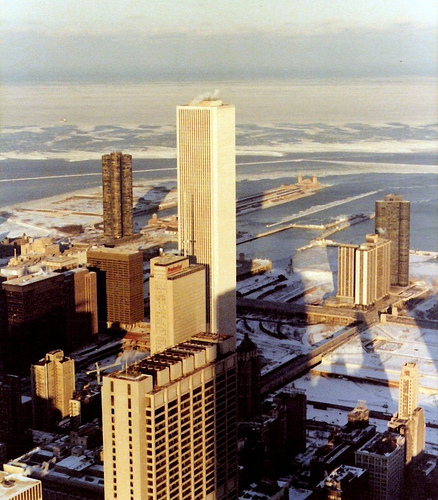
Yet More Downtown Re-Photography

…but click on the link for a nicely interactive document:

http://www.flickr.com/photos/corydalus/32762838/in/pool-gapers_block/

The H&D Curve

Wikipedia says “Ferdinand Hurter (1844–1898) and Vero Charles Driffield (1848–1915) were nineteenth-century photographic scientists who brought quantitative scientific practice to photography through the methods of sensitometry and densitometry.”

At http://blakeandrews.blogspot.com/2009_09_01_archive.html  you can scroll down to the September 24 entry for an example of a Tri-X characteristic curve, as well as parodies of H&D curves (fo-do insider jokes). In each case the curve consists of a toe (shadow tonal separation), a straight line section whose angle indicates the inherent contrast, and the shoulder, which refers to highlight separation.

Ms. H. has this bone to pick:

“Jeff,

‘For extra fine grain try T-Max 100 in either Microdol-X or Perceptol full strength. The grain rivals Technical Pan at about five times the speed and no problems with controlling contrast.’

“People were Microdol crazy when I was at school. Is this necessary? Why can’t people just invest in a tripod and use fine grain lowwwwww speed film? Straightforward and simple; slower film=better grain. Are my views skewed? I have always preferred most others over T-grain films- Is it just because my elders told me they were better? I look forward- perhaps this weekend- to enlarging some negatives to definitively answer such questions. Damn it.”

H

You’re right. A slower non-tabular grain film, exposed and processed in another standard developer, is probably preferable to fast T-Max or Delta. I suspect people find themselves in a corner once they’ve loaded a camera. Barrington Huge School standardized on D-76 until I changed it over to Microdol-X for reasons of economy, and of dealing with a host of real and anticipated exposure predicaments. Microdol-X is a fine fine-grain developer, a point which has been moot in the Wonderful World of E274 since XTOL came along. Your views aren’t skewed, they’re based on solid information and good craft.

I was first forced to try Microdol-X around 1976 or 1977 when I visited (out of desperation and a sense of adventure) a rental darkroom somewhere in Oak Park, and that’s all they had (it made me a nervous wreck). I imagine that  you’ve tried your share of formulae. Developers I’ve trusted, and which have rewarded me with excellent negatives over the years, include D-76, Microdol-X, HC-110, Rodinal (everybody genuflect, now), FG-7, D-23, Ethol T.E.C., Acufine, Diafine, D-19, Neofin Blue, FX-1, TFX-2 and PMK Pyro. Each delivered as promised when the film was correctly exposed for the “soup.”

This perspective comes from other e-mail correspondence:

“…there are two quite different films sold under the Tri-X name. One is an ISO-400 film with a medium toe, the other is an ISO-320 film with a very long toe. Both are available in 120 but the ISO-400 film is the only one available in 35mm and the ISO-320 film is the only one available as sheet film. The difference is in the tone rendition. Kodak has made a long toe film in sheet sizes for many years. It has lower shadow contrast and bright highlights. According to the Kodak data sheets its for use in low-flare conditions, i.e., in the studio with controlled lighting and modern lenses. The ISO-400 version is for general purpose use.

“Plus-X used to be the same way, the sheet version was a very long toe film. The tone rendition of the two is not radically different and plenty of people use the 320 version as a general purpose film, however, for some use, especially where one wants bright highlights, it has an advantage. The characteristic seems to be similar to the films sold many years ago as portrait films such as Kodak Portrait Panchromatic. To some degree the difference in tone rendition is evident by overlaying the curves for the two films but you really have to photograph the same subjects and compare the prints to see the actual difference.

“In comparison, T-Max films have relatively short toes, similar to the old Super-XX. The Tri-X 320 film has a curve which is upward deflected all along its length although not quite to the degree that the old Plus-X Pan Professional sheet film was. Note that the current Plus-X is a medium toe film for general use. I must say I think it is underrated by many. A very fine grain film with good tone rendition for many subjects.”