When I was a short person, I did not yet drink coffee; rather, pots and pots of black tea, and gallons of iced tea in summer. (Note: now it’s “ice” tea, and not because of the performer’s name. Language really does morph. Ice cream used to be “iced” cream, I’m told.) I did not get around to coffee until my late twenties, when I happened to sample un tres bon cafe in Paris. I came back to Chicago, wound (past tense of wend, but only when you’re in a spiral mall) up to the last storefront and whined to Bob Wells, “How can I make coffee like they have in Fraaance?” He pointed to the machines out of reach on the top shelf, machines that ran 500-800 dollars. I wanted coffee that gave the mouth feel of cocoa, but without the sweetness of added sugar. (Plus, coffee does not stain the teeth as badly.)

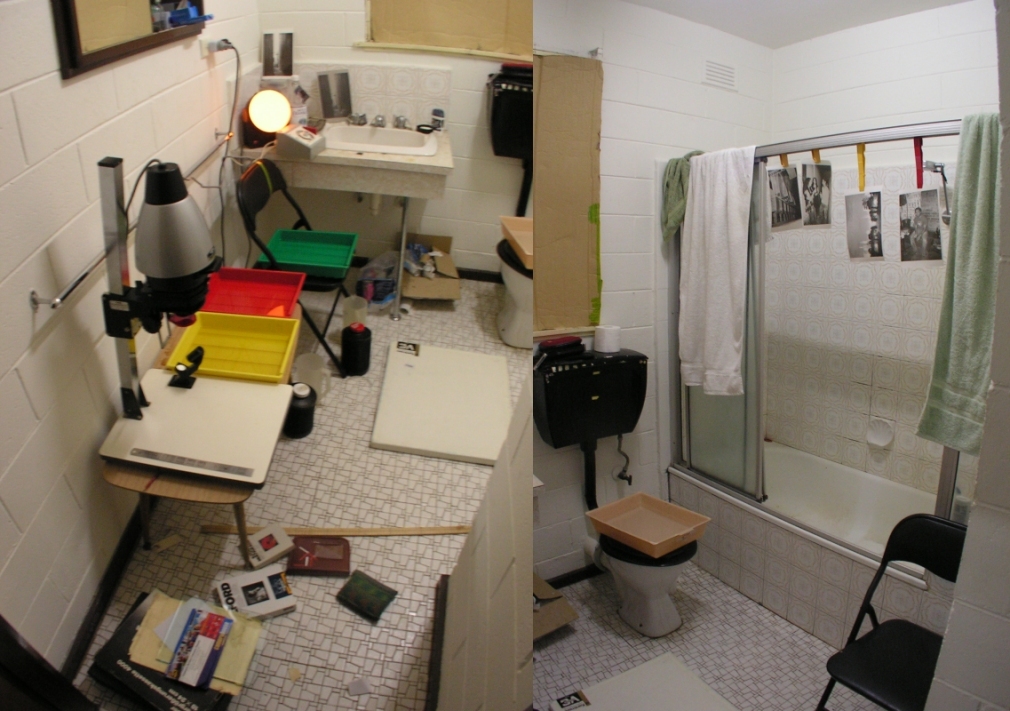
Junkies wish they could relive the exhilaration of their first-ever high each time they fix (so I’m told). Is it the same for coffee lovers? Maybe. Compare that to your (conscious or unconscious) attempt to replicate the thrill you had when your first good print came up in the developer. Whoosh, right? Just as a film and developer combination gives you a look that works for you, so can a pairing of paper and developer. Here are ideas about commercially available chemistry for your sanctum.
The K.I.S.S. approach to paper chemistry requires only developer and fixer. The standard developer is Kodak’s Dektol, whose advantage is a little contrast control through dilution. It does throw some sludge in the tray with use, however, and one may (will) acquire a sensitivity to the Metol in it over time. Those are reasons I replaced it in the Hah Thkoo with LPD, which lasts longer (get it? “L” PD), has Phenidone instead of Metol, and allows for subtle shifts of print color by dilution (and, of course, choice of paper). It comes as a can of powder to make a stock solution or as a liquid concentrate. At this writing a quart of liquid concentrate runs $13.00, typically to dilute 1:4. There are many, many choices among pre-mixed paper developers, but it’s unlikely to find anything better for the price.
The second tray in printing is usually water with acetic acid, to neutralize the (base) developer on the drained print. This stops the development, hence the term “stop bath,” and prevents that little bit of developer from contaminating the fixer. Kodak has long offered Indicator Stop Bath, which is a 28% dilution of acetic acid (like vinegar, only 5 or 6 times stronger, not food grade, and a bit more acrid one’s nostrils) with a dye mixed in. Two ounces of this in a gallon makes a yellow solution which appears clear under safelights. Once enough prints have neutralized the acid, the dye turns dark (purple) so you’ll know. In the Huge School we set up a larger tray with an overkill of just water (not “just water,” but probably the hardest tap water in the Northern Hemisphere) which does the trick and is easily replaced as the periods pass.
Fixer: simple. Once again, to avoid inhalation of nasty dusty powders, stick to liquid concentrate. Everybody has a fixer for sale. They all work. Our recommendations: Kodak Rapid Fixer, Edwal Quick Fix, or Formulary TF-4. Each runs somewhere from $10.50-12.00 for a quart of concentrate. As with film fixer, count how many sheets you run through a tray of working solution (don’t bother to add the hardener if any comes with it in a separate bottle), and retire the batch before it’s exhausted. The IEPA will receive your old batches from you (talk to me about that).
That’s it. Almost as simple as Edward Weston’s darkroom. You needn’t bother with hypo clearing agent if you use RC paper, nor fiber if you calculate a diligent wash of small batches and sufficient agitation therein. Let’s play it real safe, by you axing me a ton o’ questions afore ye shop.
2009/08/15
Categories: Darkroom, Tools & Materials . . Author: mrdplus . Comments: 1 Comment
 There was an article recently in the Home section of the Times about how a writer, Roxana Robinson, ended up writing in her tiny guest bedroom instead of the space she had designated for her work. “I did everything but write in that room,” Ms. Robinson said. “I paid bills. I printed things out. I sent faxes. I was connected to the Internet. The assumption is that writers can write wherever they can sit down. But the main thing you need as a writer is a sense of certainty that you won’t be interrupted.”




 Creative Camerawork